
Why are Veteran groups split on H.R. 9237?
The Legion says pass it. The VFW says kill it. They agree on almost everything inside it. The whole fight is about who pays, and it started with a VA rule in 2022.
By Vegas Veteran Voices,
From Every Marine Asks Where You Deployed. He Hated the Answer. / JMach & Tommy Nutz
The Legion says pass it. The VFW (Veterans of Foreign Wars) says kill it. They agree on almost everything inside it. The whole fight is about who pays, and it started with a VA rule in 2022.
By Vegas Veteran Voices
Where it stands, November 16, 2026: the House passed H.R. 9237 by voice vote on November 11, 2026. The Senate has not voted. It is not law, and nothing about your rating, your check or your care has changed because of it. Vegas Veteran Voices takes no side on this bill. This is what it says, and what people on each side say it means. Latest status
The Legion and the VFW usually sit at the same table. On this bill they are not even in the same room. The funny part is that they agree on most of what is in it.
The short answer
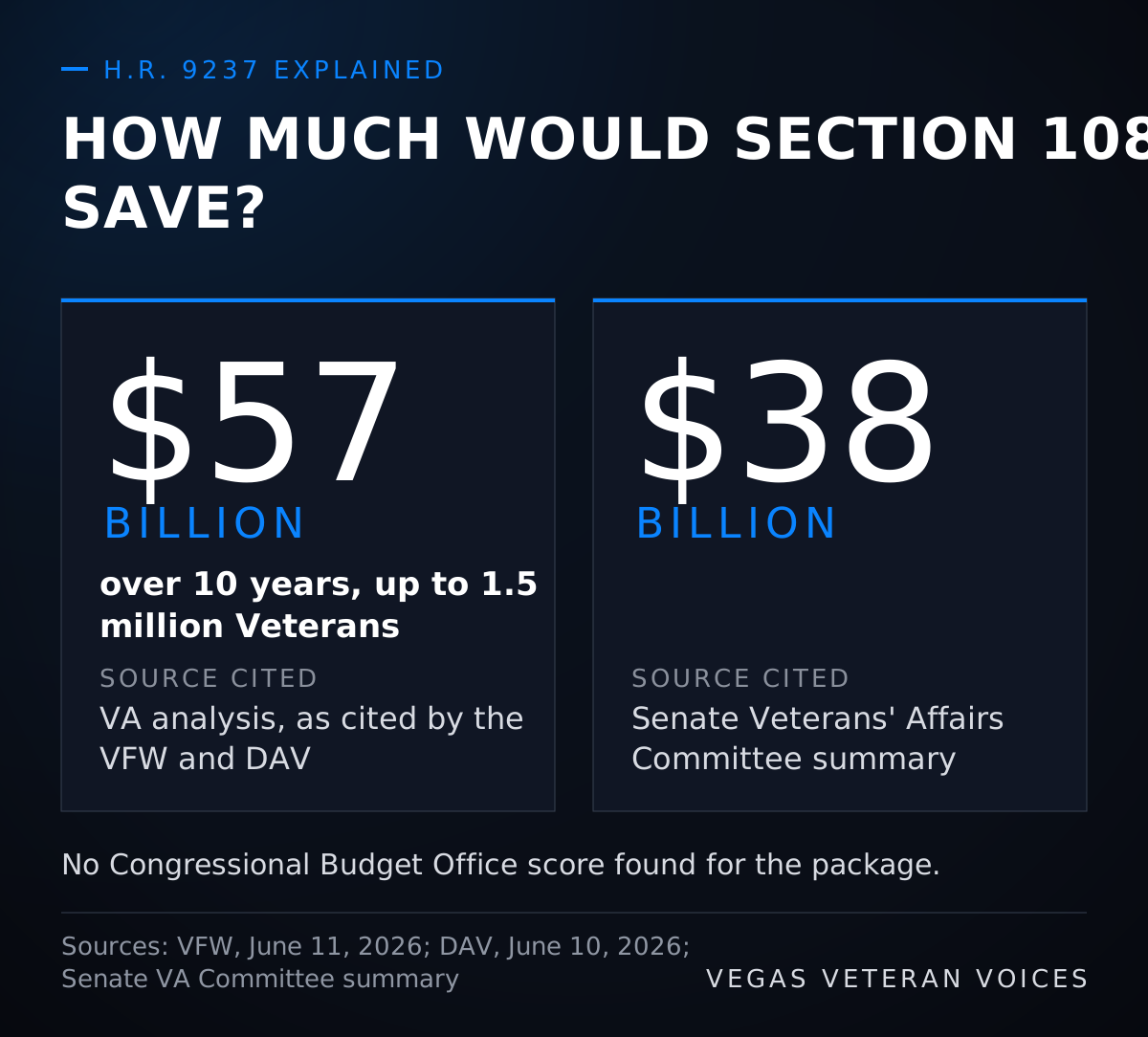
Nearly every big Veteran group wants what’s in this bill: the Star Act, Love Lives On, the survivor raises, the mental health pieces. They split over Section 108. That section changes how future sleep apnea and tinnitus claims are rated, and it helps pay for the rest. In Washington, “pay-for” means the spending cut or fee that covers the cost of new spending.
One side says that money was going away anyway and this bill at least keeps it for Veterans. The other side says you don’t pay for one generation of Veterans by cutting the next.
We take no side. Here’s each case in its own words.
Who’s where
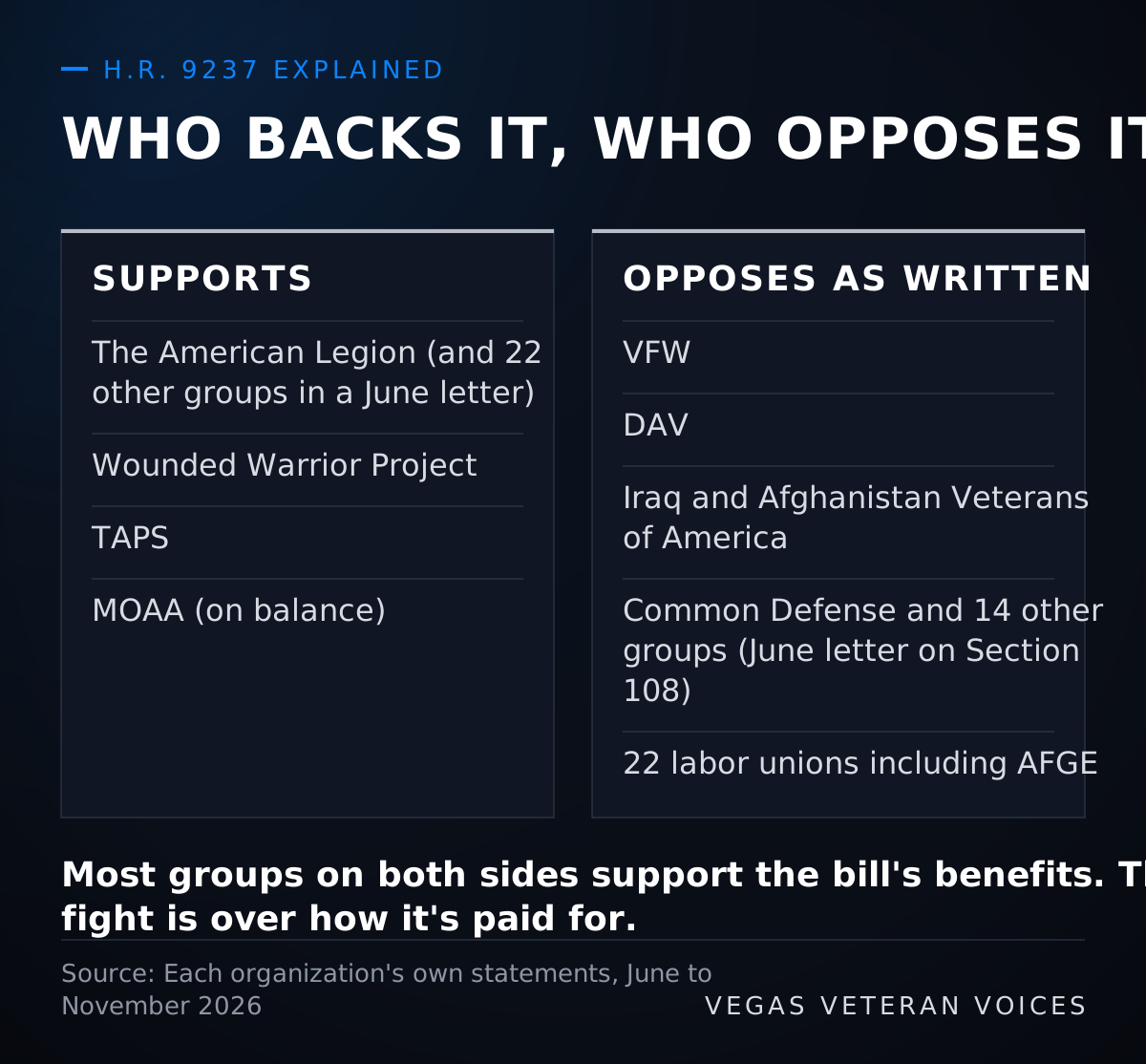
For the bill
- The American Legion. Its June article says “The American Legion and 22 other Veterans service organizations sent a coalition letter” urging passage. It describes the bill as a bipartisan package of more than 60 provisions (Legion, opened 2026-11-16).
- Wounded Warrior Project (WWP)
- TAPS, the Tragedy Assistance Program for Survivors (Military.com)
- MOAA, the Military Officers Association of America. It says it will “pragmatically support the TCAVA despite the less-than-ideal approach to funding the full legislation,” (TCAVA is the bill’s initials) and that “it represents a net expansion of benefits and support for Veterans, survivors, caregivers, and military families” (MOAA, opened 2026-11-16)
Against it as written
- The VFW, Veterans of Foreign Wars (VFW)
- DAV, Disabled American Veterans (DAV)
- Iraq and Afghanistan Veterans of America (IAVA)
- A June 22 letter from Common Defense and 14 other Veteran and military groups asking Congress to strike Section 108 entirely (Common Defense)
- A coalition of 22 labor unions including AFGE, over the VA workforce and community care sections (AFGE letter). AFGE’s Veterans Affairs council says: “Redirecting funding to community care while essentially cutting 80,000 positions is the antithesis of our goal” (Stars and Stripes, July 21, 2026, opened 2026-11-16).
Even inside the Legion it isn’t unanimous. A local Massachusetts post reported joining the Legion’s Texas and Alabama departments in opposing the bill at the August national convention (Daily Hampshire Gazette). The national Legion still backs it.
How we got here: the rule that came first
This fight is older than the bill.
- February 2022: VA proposed changing how sleep apnea and tinnitus are rated, among other conditions. The rule was never finalized.
- January 2026: a VA official told a House subcommittee that final rules for several body systems were due by the end of fiscal 2026. A VA spokesman later told Newsweek, “No changes are planned or imminent.” Newsweek also quotes Rep. Mike Bost calling the bill “the number one priority for the Veteran community right now” (Newsweek, opened 2026-11-16).
- February 2026: VA issued a separate rule about rating conditions while on medication. The VFW, DAV, The American Legion and Paralyzed Veterans of America objected, a lawsuit was filed, and within days VA stopped it. Military Times quotes VA Secretary Doug Collins saying “the department always takes Veterans’ concerns seriously” (Military Times, February 19, opened 2026-11-16).
- June 2026: more than 45 senators signed a letter led by Sen. Richard Blumenthal pushing back on VA’s ratings changes (the letter). The same month, H.R. 9237 put sleep apnea and tinnitus changes into the bill itself.
The case for the bill, in its backers’ words
- “VA/OMB will make rating changes by regulation regardless of what happens to TCAVA.” (OMB is the White House budget office) The question, the Legion says, “is whether those savings will support Veterans programs or be lost to the Treasury.” Then-National Commander Dan K. Wiley, July 17 (Legion). OMB is the White House budget office.
- “TCAVA includes no retroactive cuts.” Same statement.
- “Legislative success requires a pragmatic path forward, not just good intentions.” Wiley, June 16 (Legion).
- The Star Act has stalled for years over its cost. The Legion’s August message: the votes “aren’t there” to pass it alone in the Senate (Legion).
- After the House vote, Legion National Commander Jay Bowen: “But this is just the first step.” (Legion, November 12, opened 2026-11-16)
The case against, in its opponents’ words
- “What we cannot accept is asking one generation of Veterans to pay for another.” VFW, July 15 (VFW).
- “A grateful nation pays its debts to Veterans; it does not send them the invoice.” Then-VFW National Commander Carol Whitmore, June 11.
- DAV calls Section 108 a “poison pill” and says the changes would reach “any reassessments or reevaluations of existing claims” (DAV, June 10).
- Veterans “should not be forced to pay for new initiatives through reductions to benefits they already rely upon.” IAVA CEO Dr. Kyleanne Hunter (IAVA).
- “Once Congress starts rewriting the disability ratings whenever it needs money, there’s no limit.” IAVA’s Jess Finucan, to Government Executive (GovExec, June 25).
- “This bill pits Veterans against Veterans.” Rep. Chris Deluzio (GovExec, June 25).
- The package is “a distraction Veterans would pay for.” Rep. Mark Takano, the committee’s top Democrat (June 11).
It got personal
In July, committee chairman Mike Bost criticized “the recent inflammatory, fear-mongering and dangerous political rhetoric from the Veterans of Foreign Wars” (Stars and Stripes, July 1). The same story describes the fight as “a plan by Congress to reduce future benefits for tinnitus and sleep apnea.” After the House vote, VFW National Commander-in-Chief Cory Geisler said: “Playing political games with Veterans’ benefits while avoiding public accountability is cowardly and dishonorable” (VFW, November 11, opened 2026-11-16). Groups that usually stand on the same side of every Veterans issue are not, this time.
What it means
What changes: nothing yet. The bill passed the House on November 11 by voice vote and is not law. The Senate has its own version, S. 4744.
For whom: if it becomes law, the Section 108 rating changes would apply to future claims, and the rest of the package would apply as written. Each article in our series covers one section.
What you don’t need to worry about: picking a side to read it. We lay both out and take none.
What Veterans told us
Tommy Nutzmann, a retired U.S. Navy chief who opposes the bill:
“TCAVA is a prime example in my opinion where trying to use future Veterans to pay for current Veterans. We don’t do that.”
That’s one Veteran’s view. The Legion’s members who back the bill are Veterans too.
What we don’t know yet
- Whether the Senate keeps Section 108, changes it, or finds another way to pay.
- Whether VA would make the same changes by regulation if the bill fails, as the Legion says, or not, as VA’s own later statement suggests.
Where to go from here
For anything about your own claim, rating or benefits, talk to free accredited help. Listings are not an endorsement.
- Veterans Service Officers, VAST Las Vegas (Nevada Department of Veterans Services). Free, state-employed service officers who help Veterans file and follow VA claims in Las Vegas.
- Find a VA-accredited representative. VA’s own search for free accredited help, by ZIP code.
- H.R. 9237 on Congress.gov. The bill’s official page: text, every action and its status.
If you are a Veteran in crisis or having thoughts of suicide, call 988 and press 1, or text 838255. The Veterans Crisis Line is free and confidential, 24 hours a day.
More on H.R. 9237
Start at the full guide to H.R. 9237.
Ratings and claims: Will H.R. 9237 cut sleep apnea ratings? · Will H.R. 9237 cut tinnitus ratings? · I’m already rated. What happens to me under H.R. 9237? · What does the October 1, 2026 date in H.R. 9237 mean for my claim? · Does H.R. 9237 change PTSD or other VA ratings? · Is H.R. 9237 a $57 billion cut to Veterans’ benefits? · Can VA deny my claim for missing a C&P exam under H.R. 9237? · What does H.R. 9237 change about VA appeals? · What does H.R. 9237 change about C&P exams? · Will H.R. 9237 make VA letters and forms easier to read? · What does H.R. 9237 change for MST claims?
Money, survivors and home loans: What does H.R. 9237 do with the Major Richard Star Act? · TCAVA’s Star Act vs the standalone Star Act: what’s the difference? · Can surviving spouses remarry without losing benefits under H.R. 9237? · What does H.R. 9237 change for DIC and ALS survivors? · What is the $833.33 a month in H.R. 9237? · Does H.R. 9237 raise VA home loan fees? · Can Guard and Reserve get a VA home loan under H.R. 9237?
School, jobs and getting out: What does H.R. 9237 change about the GI Bill? · Does H.R. 9237 raise GI Bill apprenticeship pay? · What does H.R. 9237 change about TAP and SkillBridge?
Mental health and care: What does H.R. 9237 do to the Fox suicide prevention grants? · What are the mental health care grants in H.R. 9237? · Will H.R. 9237 make it easier to get into VA residential treatment? · Can VA prescribe controlled medications by telehealth under H.R. 9237? · What does H.R. 9237 do about opioid overdoses? · Does H.R. 9237 pay for service dogs? · What does H.R. 9237 do for TBI and blast exposure? · What does H.R. 9237 do for caregivers? · What does H.R. 9237 change about how Veteran deaths are counted? · What does H.R. 9237 do for women Veterans? · What does H.R. 9237 do for Veterans with spinal cord injuries? · What does H.R. 9237 do for prosthetics, adaptive sports and car adaptations? · Does H.R. 9237 study the children of toxic-exposed Veterans?
The VA system: What does H.R. 9237 change about community care? · Does H.R. 9237 privatize the VA? · What does H.R. 9237 do for rural Veterans? · What does H.R. 9237 change for Veterans on VA and Medicare? · Which new VA hospitals are in H.R. 9237? · What does H.R. 9237 mean for VA staff? · Will H.R. 9237 fix VA scheduling and phone calls? · What does H.R. 9237 change for burial benefits and headstones?
The politics: Where does H.R. 9237 stand, and what happens next? · Why was H.R. 9237 passed by voice vote?