
Does H.R. 9237 pay for service dogs?
Not directly. It would pay nonprofits to place service dogs with eligible Veterans, then hand each Veteran a veterinary insurance policy. PTSD and TBI are on the list.
By Vegas Veteran Voices,
Not directly. It would pay nonprofits to place service dogs with eligible Veterans, then hand each Veteran a veterinary insurance policy. PTSD (post-traumatic stress disorder) and TBI (traumatic brain injury) are on the list.
By Vegas Veteran Voices
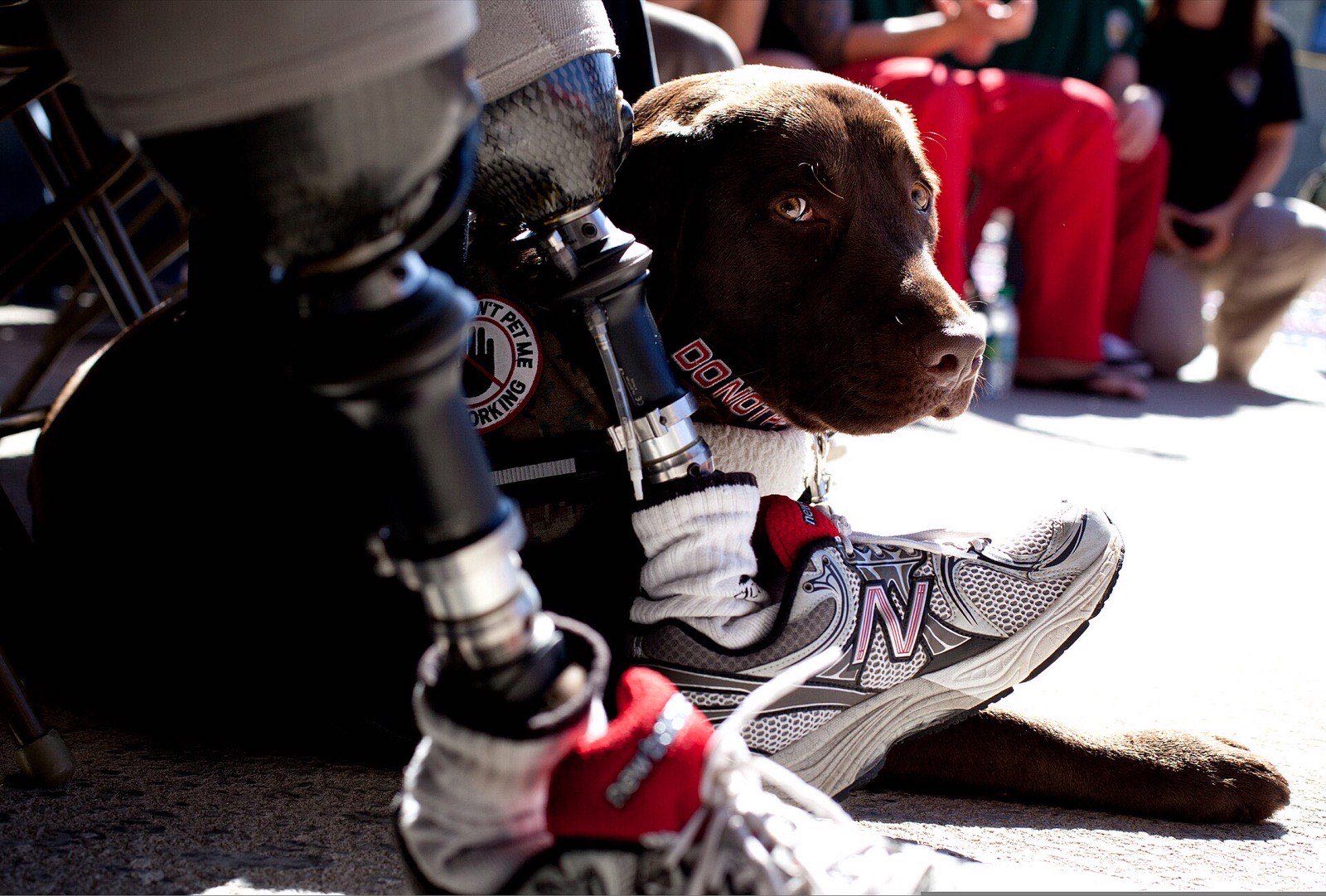 U.S. Marine Corps photo by Lance Cpl. Chelsea Flowers. File photo; the people shown are not connected to this bill.
Where it stands, November 16, 2026: the House passed H.R. 9237 by voice vote on November 11, 2026. The Senate has not voted. It is not law, and nothing about your rating, your check or your care has changed because of it. Vegas Veteran Voices takes no side on this bill. This is what it says, and what people on each side say it means. Latest status
The short answer
The dog does not come from VA. It would come from a nonprofit, and VA would pay the nonprofit.
The bill sets up a VA pilot program that awards “grants, on a competitive basis,” “to nonprofit entities to provide service dogs to eligible Veterans.” A pilot is a trial run. The money goes to the nonprofits, not to Veterans. A Veteran who gets a dog this way pays no fee, and VA provides a “commercially available veterinary insurance policy for the service dog.” The bill authorizes $10,000,000 a year for three years and ends the pilot’s authority on September 30, 2029.
What VA does today
VA says it does not supply dogs. A VA research center page says “VA does not provide Service Dogs but does provide this insurance benefit for eligible Veterans” (VA MIRECC, service dogs). A VA Palo Alto page says “VA doesn’t train service dogs, but your doctor can help you find a partner organization that does” (VA Palo Alto, PAWS). The same page says of VA’s PAWS pilot, where Veterans help train dogs, “No, you will not receive a service animal after completing the PAWS Pilot Program.”
VA’s Prosthetic and Sensory Aids Service page lists a service dog veterinary benefit among its programs (VA Prosthetics). So today the dog comes from somewhere else. VA covers vet care for some. This bill would pay the groups that supply them.
Where to see it in the bill
- Introduced text, Section 330. Pages 306 to 314.
- House version, Section 329. The Record numbers it differently, so we cite by title and page: “Department of Veterans Affairs pilot program to award grants for the provision of service dogs to Veterans,” Congressional Record, July 16, 2026, page H4580.
- What the House version changes. Two cross-reference fixes. The introduced text says a grant is capped “except as provided in subparagraph (B),” and there is no subparagraph (B). The House version drops that phrase. The definition of “service dog” pointed to the wrong paragraph in the introduced text and points to the right one in the House version. Nothing else differs.
What it says
-
Timing. VA must set up the pilot within 24 months of enactment, and it runs “during the three-year period beginning on the date on which the first grant is awarded” (introduced page 306, line 18, through page 307, line 4).
-
Who applies. Nonprofits, with a plan for the dogs, the training they give Veterans, the training of the dogs, support afterward, “humane standards for animals,” and “demonstrated experience” training service dogs under the Americans with Disabilities Act (pages 307 to 308).
-
How much. A grant “may not exceed $2,000,000 in a fiscal year” (page 309, lines 1 to 4). The pilot is authorized “$10,000,000 for each of the three consecutive fiscal years” (page 313, lines 14 to 18).
-
What Veterans get. The grantee must tell each Veteran VA paid “in whole or in part” for the dog, explain the benefits available for the Veteran and the dog, and “may not charge a fee” (page 310). VA gives each Veteran the vet insurance policy and keeps it going “without regard to the continuation or termination of the pilot program.”
-
Who counts as an eligible Veteran. Someone a physician says has a qualifying condition, and who is enrolled in VA health care or otherwise entitled to it. The conditions listed:
- “Blindness or visual impairment”
- “Loss of use of a limb, paralysis, or other significant mobility issue”
- “Loss of hearing”
- “Post-traumatic stress disorder”
- “Traumatic brain injury”
- Any other condition where VA decides, “based on medical judgment,” that a service dog is “optimal” for managing it and living independently
(Page 312, lines 1 to 25, through page 313, line 2.)
What counts as a service dog
A “dog that is individually trained to do work or perform tasks” that benefit a Veteran with one of those conditions and are “directly related to the disability, condition, or diagnosis of the Veteran” (page 313, lines 6 to 13). The section does not mention emotional support animals.
What it means
What changes: nonprofits that train service dogs could be paid by VA to place them with Veterans, and the Veteran gets a vet insurance policy that outlasts the pilot.
For whom: Veterans with one of the listed conditions who are in VA care. The Veteran’s part is to be enrolled or entitled to VA care, have a qualifying condition confirmed by a physician, and be matched by a funded nonprofit.
Starting when: VA has up to 24 months after the bill becomes law to set it up. The bill is not law.
What you don’t need to worry about: nothing here changes the vet insurance benefit VA offers today or takes anything away.
Whether a nonprofit near you applies, and wins, decides whether a dog is ever on offer.
Who it helps
Veterans with one of the listed conditions who are in VA care, and nonprofits that already train service dogs to ADA standards.
Where the bill stands
The House passed H.R. 9237 by voice vote on November 11. Military.com reports “the measure still requires Senate approval before it can be sent to President Donald Trump” (Military.com). Stars and Stripes says the package “bundles together 62 bills for expanding benefits and health care services for Veterans” (Stripes, November 12).
What we don’t know yet
- The pilot’s real end. The bill says three years from the first grant and also ends VA’s authority September 30, 2029. Depending on when the law passes and when the first grant goes out, those two dates may not line up. The bill does not say which wins.
- How many dogs the money buys. The bill states no figure.
- How VA picks among nonprofits. It sets application contents, not a scoring method.
- Whether the Senate keeps it. We found no Congressional Budget Office score.
Where to go from here
For anything about your own claim, rating or benefits, talk to free accredited help. Listings are not an endorsement.
- Veterans Service Officers, VAST Las Vegas (Nevada Department of Veterans Services). Free, state-employed service officers who help Veterans file and follow VA claims in Las Vegas.
- Find a VA-accredited representative. VA’s own search for free accredited help, by ZIP code.
- H.R. 9237 on Congress.gov. The bill’s official page: text, every action and its status.
If you are a Veteran in crisis or having thoughts of suicide, call 988 and press 1, or text 838255. The Veterans Crisis Line is free and confidential, 24 hours a day.
More on H.R. 9237
Start at the full guide to H.R. 9237.
Ratings and claims: Will H.R. 9237 cut sleep apnea ratings? · Will H.R. 9237 cut tinnitus ratings? · I’m already rated. What happens to me under H.R. 9237? · What does the October 1, 2026 date in H.R. 9237 mean for my claim? · Does H.R. 9237 change PTSD or other VA ratings? · Is H.R. 9237 a $57 billion cut to Veterans’ benefits? · Can VA deny my claim for missing a C&P exam under H.R. 9237? · What does H.R. 9237 change about VA appeals? · What does H.R. 9237 change about C&P exams? · Will H.R. 9237 make VA letters and forms easier to read? · What does H.R. 9237 change for MST claims?
Money, survivors and home loans: What does H.R. 9237 do with the Major Richard Star Act? · TCAVA’s Star Act vs the standalone Star Act: what’s the difference? · Can surviving spouses remarry without losing benefits under H.R. 9237? · What does H.R. 9237 change for DIC and ALS survivors? · What is the $833.33 a month in H.R. 9237? · Does H.R. 9237 raise VA home loan fees? · Can Guard and Reserve get a VA home loan under H.R. 9237?
School, jobs and getting out: What does H.R. 9237 change about the GI Bill? · Does H.R. 9237 raise GI Bill apprenticeship pay? · What does H.R. 9237 change about TAP and SkillBridge?
Mental health and care: What does H.R. 9237 do to the Fox suicide prevention grants? · What are the mental health care grants in H.R. 9237? · Will H.R. 9237 make it easier to get into VA residential treatment? · Can VA prescribe controlled medications by telehealth under H.R. 9237? · What does H.R. 9237 do about opioid overdoses? · What does H.R. 9237 do for TBI and blast exposure? · What does H.R. 9237 do for caregivers? · What does H.R. 9237 change about how Veteran deaths are counted? · What does H.R. 9237 do for women Veterans? · What does H.R. 9237 do for Veterans with spinal cord injuries? · What does H.R. 9237 do for prosthetics, adaptive sports and car adaptations? · Does H.R. 9237 study the children of toxic-exposed Veterans?
The VA system: What does H.R. 9237 change about community care? · Does H.R. 9237 privatize the VA? · What does H.R. 9237 do for rural Veterans? · What does H.R. 9237 change for Veterans on VA and Medicare? · Which new VA hospitals are in H.R. 9237? · What does H.R. 9237 mean for VA staff? · Will H.R. 9237 fix VA scheduling and phone calls? · What does H.R. 9237 change for burial benefits and headstones?
The politics: Why are Veteran groups split on H.R. 9237? · Where does H.R. 9237 stand, and what happens next? · Why was H.R. 9237 passed by voice vote?