
Does H.R. 9237 raise VA home loan fees?
Two fees go up: the streamline refinance nearly triples and the assumption fee doubles. Most disabled Veterans are exempt. Here's who pays and the line that does it.
By Vegas Veteran Voices,
 U.S. Veterans Administration poster, via U.S. National Archives.
Where it stands, November 16, 2026: the House passed H.R. 9237 by voice vote on November 11, 2026. The Senate has not voted. It is not law, and nothing about your rating, your check or your care has changed because of it. Vegas Veteran Voices takes no side on this bill. This is what it says, and what people on each side say it means. Latest status
Almost nobody talking about this bill is talking about this part. Section 104 changes two numbers in the VA home loan fee table, and one of them nearly triples. If you’re rated, breathe: you probably don’t pay it. If you’re not, keep reading.
The short answer
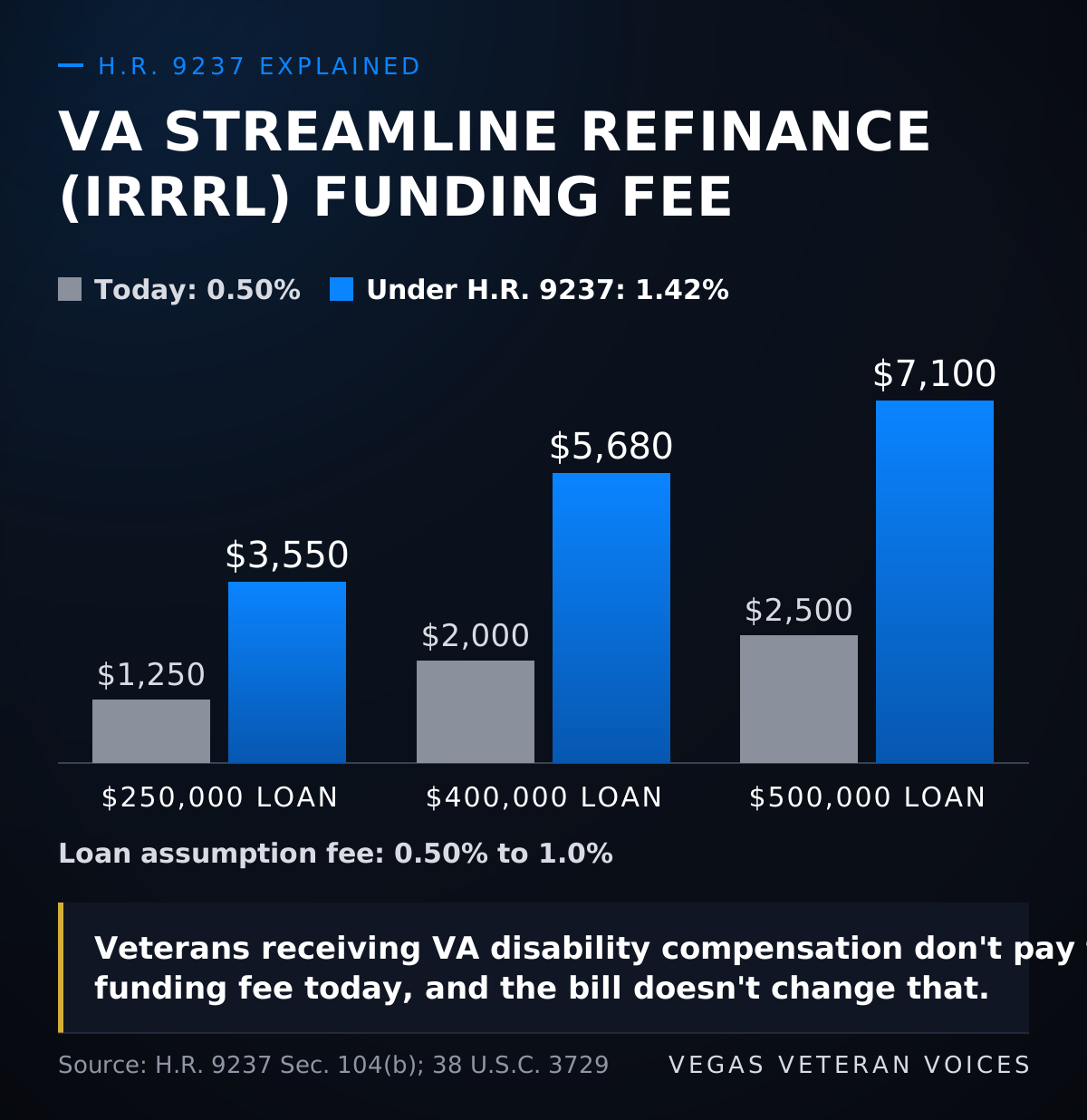
Yes, two of them. The VA funding fee is a one-time charge on a VA-backed home loan. It is how the program pays for itself. Section 104(b) would raise it on an Interest Rate Reduction Refinance Loan (IRRRL, the streamline refi, a quick refinance of an existing VA loan) from 0.50% to 1.42%. On a loan assumption, where a buyer takes over a seller’s VA loan, it goes from 0.50% to 1.0%.
Veterans who receive VA disability compensation don’t pay the funding fee today, and the bill doesn’t change that. Section 104(c) also opens VA home loans to more Guard and Reserve members, at a higher fee.
Where to see it in the bill
- Fee increases, Section 104(b). House version: Congressional Record page H4551, with an effective date of “October 1, 2026.” Introduced text: page 17, lines 11 to 17, which has no fee effective date. The bill changes two entries in the fee table in 38 U.S.C. 3729(b)(2): the IRRRL line (“striking ‘0.50’ both places … inserting ‘1.42’”) and the assumption line (“striking ‘0.50’ each place … inserting ‘1.0’”).
- Guard and Reserve, Section 104(c). House version: Record page H4551. Introduced text: pages 18 to 21.
What the official pages say today
VA’s funding fee page lists “Interest rate reduction refinancing loans (IRRRL)” at 0.5%, and starts its exemption list with “You won’t have to pay a VA funding fee if any of these descriptions are true for you:” (VA funding fee and closing costs, opened 2026-11-16). That matches the 0.50% the bill would change.
On what an IRRRL is, VA says: “Refinancing lets you replace your current loan with a new one under different terms” (VA, Interest Rate Reduction Refinance Loan, opened 2026-11-16).
What it costs, if you’re not exempt
| Loan amount | IRRRL fee today (0.50%) | Under the bill (1.42%) | Difference |
|---|---|---|---|
| $250,000 | $1,250 | $3,550 | $2,300 |
| $400,000 | $2,000 | $5,680 | $3,680 |
| $500,000 | $2,500 | $7,100 | $4,600 |
That math is ours, from the bill’s percentages. Most borrowers roll the fee into the loan, so they also pay interest on it. On an assumption, a $300,000 balance would go from a $1,500 fee to $3,000.
Who is exempt
Under current law, which the bill does not change, the statute says “A fee may not be collected under this section from a Veteran who is receiving compensation” (38 U.S.C. 3729(c), Cornell Law, opened 2026-11-16). The same subsection also covers a surviving spouse of a Veteran who died from a service-connected disability, and an active-duty member who has been awarded the Purple Heart. So the increase falls mainly on active-duty borrowers, Veterans without a disability rating, and Guard and Reserve members.
The recoupment detail
VA requires a streamline refinance’s costs to be recouped within 36 months. The statute says costs must be recouped “on or before the date that is 36 months after the date of loan issuance” (38 U.S.C. 3709, Cornell Law, opened 2026-11-16). That calculation leaves out “fees paid under this chapter,” which appears to include the funding fee. So a bigger funding fee wouldn’t make a refinance fail VA’s test, even if it takes the borrower longer to actually break even.
Guard and Reserve (Section 104(c))
The bill adds a definition of “active duty” for home loans that lets more Guard and Reserve members qualify. The introduced text (the House version dropped one National Guard item, covered on the Guard and Reserve page) requires “a total service of at least 14 days on active duty” under specific orders, and that the member “continued to serve until the completion of entry level and skill training,” and is not otherwise eligible (page 20, lines 3 to 15). Those borrowers would pay the table rate plus one extra point, “adding 1.00 to the percentage in the table” (page 21, lines 1 to 6). The new definition reaches back to service on or after September 11, 2001.
What it means
What changes: two fee lines on the VA table go up, and a Guard and Reserve door opens at a higher fee.
For whom: borrowers who aren’t exempt. A refinance into a lower rate costs more up front. A buyer taking over a low-rate VA loan pays more to assume it.
Starting when: “October 1, 2026” in the House version. That date has already passed on the calendar, and the bill is not law, so we can’t tell you how it would apply.
What you don’t need to worry about: the fee on a regular purchase loan, which these two lines do not touch, and the fee itself if you receive VA compensation.
What it could mean
- For the package: the fee increases sit in the same section as the $833.33 monthly allowance for the most severely disabled. The bill does not say those fees pay for the allowance.
- Coverage: most reporting has focused on Section 108. The VFW’s (Veterans of Foreign Wars) June statement objects to “offsets, fee increases, or reductions” that burden Veterans, military families and survivors (VFW, June 11, 2026).
What we don’t know yet
- The final effective date (October 1, 2026 in the House version).
- Whether the Senate keeps the fee changes.
Today’s fees are the ones on VA’s page above. A lender or a HUD (Department of Housing and Urban Development)-approved housing counselor can run your numbers.
Where to go from here
For anything about your own claim, rating or benefits, talk to free accredited help. Listings are not an endorsement.
- Veterans Service Officers, VAST Las Vegas (Nevada Department of Veterans Services). Free, state-employed service officers who help Veterans file and follow VA claims in Las Vegas.
- Find a VA-accredited representative. VA’s own search for free accredited help, by ZIP code.
- H.R. 9237 on Congress.gov. The bill’s official page: text, every action and its status.
If you are a Veteran in crisis or having thoughts of suicide, call 988 and press 1, or text 838255. The Veterans Crisis Line is free and confidential, 24 hours a day.
More on H.R. 9237
Start at the full guide to H.R. 9237.
Ratings and claims: Will H.R. 9237 cut sleep apnea ratings? · Will H.R. 9237 cut tinnitus ratings? · I’m already rated. What happens to me under H.R. 9237? · What does the October 1, 2026 date in H.R. 9237 mean for my claim? · Does H.R. 9237 change PTSD or other VA ratings? · Is H.R. 9237 a $57 billion cut to Veterans’ benefits? · Can VA deny my claim for missing a C&P exam under H.R. 9237? · What does H.R. 9237 change about VA appeals? · What does H.R. 9237 change about C&P exams? · Will H.R. 9237 make VA letters and forms easier to read? · What does H.R. 9237 change for MST claims?
Money, survivors and home loans: What does H.R. 9237 do with the Major Richard Star Act? · TCAVA’s Star Act vs the standalone Star Act: what’s the difference? · Can surviving spouses remarry without losing benefits under H.R. 9237? · What does H.R. 9237 change for DIC and ALS survivors? · What is the $833.33 a month in H.R. 9237? · Can Guard and Reserve get a VA home loan under H.R. 9237?
School, jobs and getting out: What does H.R. 9237 change about the GI Bill? · Does H.R. 9237 raise GI Bill apprenticeship pay? · What does H.R. 9237 change about TAP and SkillBridge?
Mental health and care: What does H.R. 9237 do to the Fox suicide prevention grants? · What are the mental health care grants in H.R. 9237? · Will H.R. 9237 make it easier to get into VA residential treatment? · Can VA prescribe controlled medications by telehealth under H.R. 9237? · What does H.R. 9237 do about opioid overdoses? · Does H.R. 9237 pay for service dogs? · What does H.R. 9237 do for TBI and blast exposure? · What does H.R. 9237 do for caregivers? · What does H.R. 9237 change about how Veteran deaths are counted? · What does H.R. 9237 do for women Veterans? · What does H.R. 9237 do for Veterans with spinal cord injuries? · What does H.R. 9237 do for prosthetics, adaptive sports and car adaptations? · Does H.R. 9237 study the children of toxic-exposed Veterans?
The VA system: What does H.R. 9237 change about community care? · Does H.R. 9237 privatize the VA? · What does H.R. 9237 do for rural Veterans? · What does H.R. 9237 change for Veterans on VA and Medicare? · Which new VA hospitals are in H.R. 9237? · What does H.R. 9237 mean for VA staff? · Will H.R. 9237 fix VA scheduling and phone calls? · What does H.R. 9237 change for burial benefits and headstones?
The politics: Why are Veteran groups split on H.R. 9237? · Where does H.R. 9237 stand, and what happens next? · Why was H.R. 9237 passed by voice vote?