
Will H.R. 9237 cut sleep apnea ratings?
Today a CPAP gets you 50%. Under Section 108, a CPAP that works gets you zero. Who it would hit, who it wouldn't, and the exact lines.
By Vegas Veteran Voices,
Today a CPAP (continuous positive airway pressure) gets you 50%. Under Section 108, a CPAP that works gets you zero. Who it would hit, who it wouldn’t, and the exact lines.
By Vegas Veteran Voices
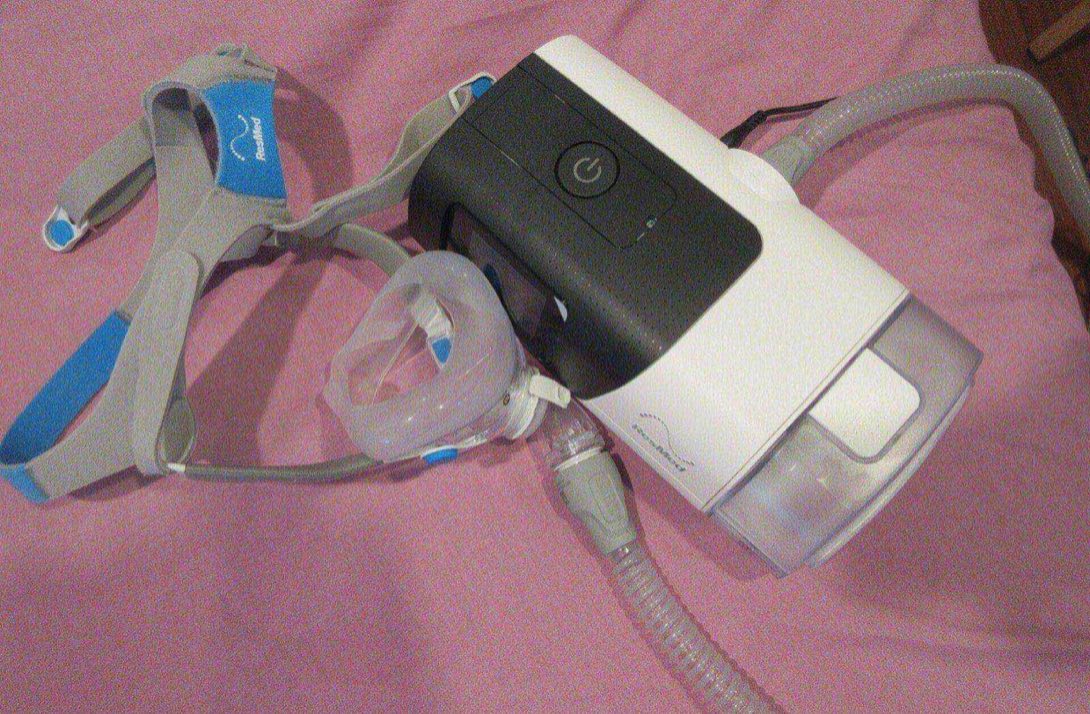 Photo: Infrogmation, CC BY-SA 4.0, via Wikimedia Commons.
Where it stands, November 16, 2026: the House passed H.R. 9237 by voice vote on November 11, 2026. The Senate has not voted. It is not law, and nothing about your rating, your check or your care has changed because of it. Vegas Veteran Voices takes no side on this bill. This is what it says, and what people on each side say it means. Latest status
Here’s the deal in one line. Today, if your service-connected sleep apnea means you sleep with a machine strapped to your face, that’s 50%. Under Section 108, if that machine does its job, that’s zero. Read that twice, then read the protection for current ratings below before you panic.
Quick terms. Sleep apnea is when your breathing stops and starts while you sleep. A CPAP is the machine and mask that keep your airway open. “Rating” is the percentage VA assigns a condition, which sets the monthly pay. “Comorbid conditions” means other health problems at the same time. “End-organ damage” means the condition has harmed organs in the body.
The short answer
If you are rated for sleep apnea today, the bill text says the change cannot be used to reduce what you already get. If you file a sleep apnea claim under the new rules, needing a CPAP would no longer earn 50% on its own. A treatment that works would rate 0%. The bill is not law, so nothing has changed yet.
Where to see it in the bill
- Section 108(a), “Ratings for sleep apnea.” House version: Congressional Record, July 16, 2026, page H4555. Introduced text: page 59, lines 11 to 24, and page 60, lines 1 to 10.
- Who it applies to, Section 108(c). House version: “claims filed on or after October 1, 2026” (Record page H4555). Introduced text: “claims filed after the date of the enactment” (page 61, lines 1 to 5).
- Protection for current ratings, Section 108(c). Both versions: the changes “may not serve as the basis for reducing, discontinuing, or otherwise adversely affecting compensation that was in effect on the day before the date of the enactment” (introduced page 61, lines 6 to 12).
Today versus the bill
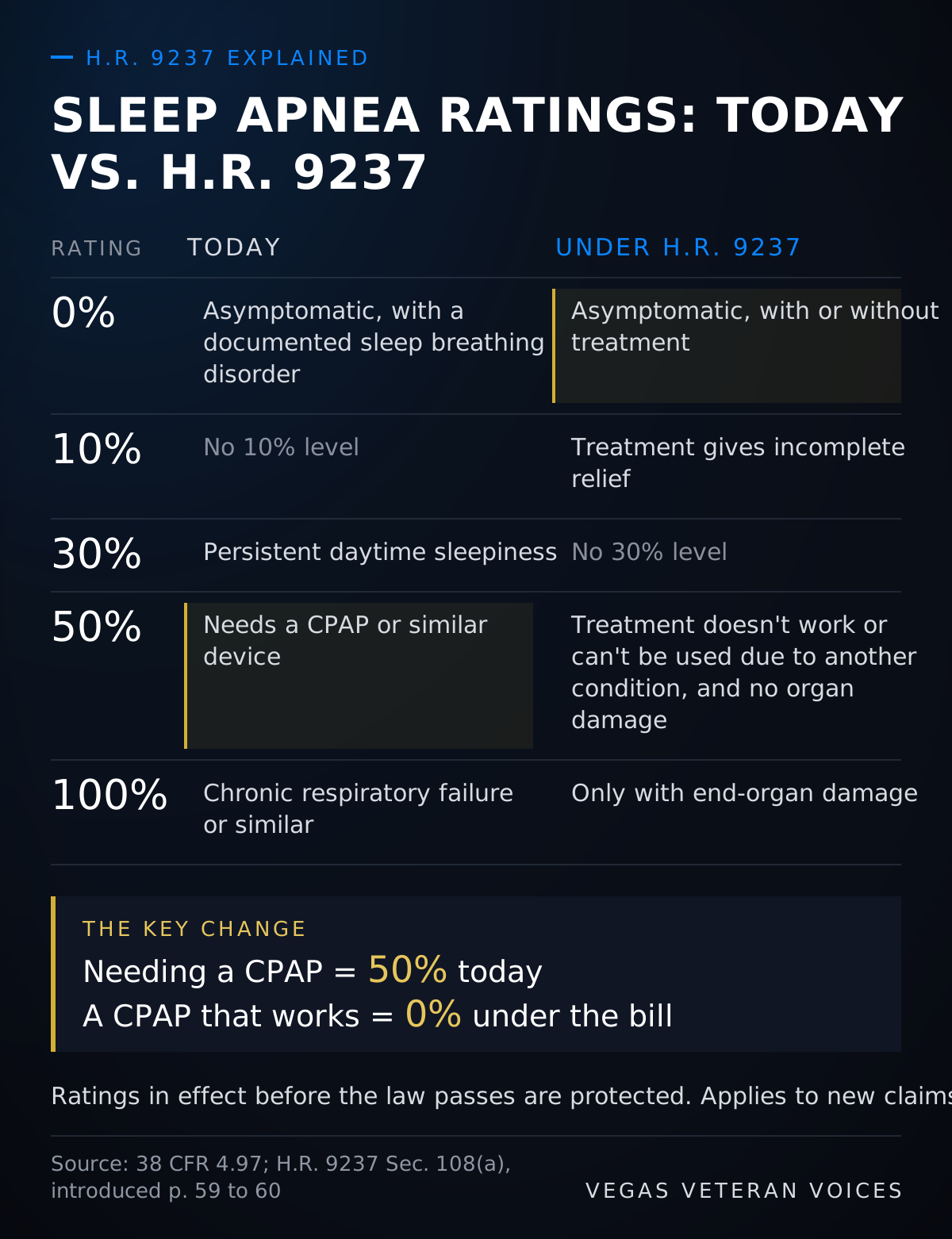
| Rating | Today (38 CFR 4.97, code 6847) | Under Section 108 |
|---|---|---|
| 0% | “Asymptomatic but with documented sleep disorder breathing” | “asymptomatic, with or without treatment” |
| 10% | (no 10% level) | “treatment yields incomplete relief” |
| 30% | “Persistent day-time hypersomnolence” | (no 30% level) |
| 50% | “Requires use of breathing assistance device such as continuous airway pressure (CPAP) machine” | “only if” treatment “is either ineffective or the Veteran is unable to use the prescribed treatment due to comorbid conditions” and “there is no end-organ damage” |
| 100% | “Chronic respiratory failure with carbon dioxide retention or cor pulmonale, or; requires tracheostomy” | “only if there is also end-organ damage” |
What it means
What changes, for whom, starting when: new sleep apnea claims would be rated by how well treatment works, not by whether you need a machine. The House version says claims filed on or after October 1, 2026. The introduced text says after enactment. The bill is not law, so nothing has changed. Newsweek puts it plainly: “No new law has changed Veterans’ sleep apnea or tinnitus ratings through H.R. 9237” (Newsweek).
What you don’t need to worry about: a rating you already have, per the protection clause above.
Today the rating follows the treatment: if you need the machine, that’s 50%. Under the bill, the rating follows how well the treatment works. Machine works, you’re at zero. Machine helps but not all the way, 10%. Machine doesn’t work, or another condition keeps you from using it, 50%. Your organs are already damaged, 100%.
In dollars: 10% pays $180.42 a month in 2026, and 50% pays a good deal more (VA’s 2026 rates). For a single Veteran with no dependents, a sleep apnea claim that would have been rated 50% and is instead rated 0% or 10% is the difference between a rating that pays and one that pays little or nothing.
How many people it touches: VA’s FY2025 (fiscal year) Annual Benefits Report counts 763,763 service-connected sleep apnea disabilities (VA ABR, compensation section). Those are current ratings, which the text protects. The change would fall on claims filed under the new rules.
What it could mean: what each side says
- The VFW (Veterans of Foreign Wars) says the change asks future disabled Veterans to bear the cost of the bill’s other benefits, and calls Section 108 a precedent: for the first time, rating changes written into law to produce budget savings (VFW, November 11, 2026).
- DAV (Disabled American Veterans) calls the change a “poison pill” and points readers to “Section 108 on page 59” (DAV, June 10, 2026).
- The American Legion says “TCAVA includes no retroactive cuts,” (TCAVA is the bill’s initials) that “VA/OMB will make rating changes by regulation regardless of what happens to TCAVA,” (OMB is the White House budget office) and that the real question “is whether those savings will support Veterans programs or be lost to the Treasury” (Legion, July 17, 2026).
- The backstory: VA first proposed rating sleep apnea by how well treatment works in February 2022, and the rule has not been finalized. Newsweek reports VA’s line this way: “VA anticipates publishing the final rules for all four body systems in three rulemakings by the end of FY 2026,” and also “No changes are planned or imminent” (Newsweek). The bill would make the sleep apnea change law instead of a rule.
- The treatment question: critics argue that rating a condition by how well treatment works can push some Veterans to skip treatment. When VA briefly issued a separate rule in February 2026 to rate conditions while on medication, it pulled the rule within days after the VFW, DAV, The American Legion and Paralyzed Veterans of America objected. Military Times wrote that “The change also drew backlash from politicians who called for it to be rescinded” (Military Times, February 19). A week later it reported the rescission “will be effective immediately on publication” (February 26). That rule and Section 108 are different, but the argument is the same one.
One thing to say plainly: the bill does not change today’s ratings, and it is not law. Questions about your own claim go to a free accredited service officer.
Where the bill stands
The House passed H.R. 9237 by voice vote on November 11. Military Times reports “The package includes more than 60 provisions” (Military Times, November 12). Stars and Stripes says Democrats and the VFW slammed the House adoption (Stripes, November 12). The Senate has not acted.
What we don’t know yet
- Which date the final law will use. The House version says October 1, 2026; the introduced text says the day it becomes law. The Senate can change it.
- How VA would handle a claim for an increase on a sleep apnea rating you already have, or a routine re-exam. See I’m already rated. What happens to me?
- How VA would write the regulations that put it into effect.
Where to go from here
For anything about your own claim, rating or benefits, talk to free accredited help. Listings are not an endorsement.
- Veterans Service Officers, VAST Las Vegas (Nevada Department of Veterans Services). Free, state-employed service officers who help Veterans file and follow VA claims in Las Vegas.
- Find a VA-accredited representative. VA’s own search for free accredited help, by ZIP code.
- H.R. 9237 on Congress.gov. The bill’s official page: text, every action and its status.
If you are a Veteran in crisis or having thoughts of suicide, call 988 and press 1, or text 838255. The Veterans Crisis Line is free and confidential, 24 hours a day.
More on H.R. 9237
Start at the full guide to H.R. 9237.
Ratings and claims: Will H.R. 9237 cut tinnitus ratings? · I’m already rated. What happens to me under H.R. 9237? · What does the October 1, 2026 date in H.R. 9237 mean for my claim? · Does H.R. 9237 change PTSD or other VA ratings? · Is H.R. 9237 a $57 billion cut to Veterans’ benefits? · Can VA deny my claim for missing a C&P exam under H.R. 9237? · What does H.R. 9237 change about VA appeals? · What does H.R. 9237 change about C&P exams? · Will H.R. 9237 make VA letters and forms easier to read? · What does H.R. 9237 change for MST claims?
Money, survivors and home loans: What does H.R. 9237 do with the Major Richard Star Act? · TCAVA’s Star Act vs the standalone Star Act: what’s the difference? · Can surviving spouses remarry without losing benefits under H.R. 9237? · What does H.R. 9237 change for DIC and ALS survivors? · What is the $833.33 a month in H.R. 9237? · Does H.R. 9237 raise VA home loan fees? · Can Guard and Reserve get a VA home loan under H.R. 9237?
School, jobs and getting out: What does H.R. 9237 change about the GI Bill? · Does H.R. 9237 raise GI Bill apprenticeship pay? · What does H.R. 9237 change about TAP and SkillBridge?
Mental health and care: What does H.R. 9237 do to the Fox suicide prevention grants? · What are the mental health care grants in H.R. 9237? · Will H.R. 9237 make it easier to get into VA residential treatment? · Can VA prescribe controlled medications by telehealth under H.R. 9237? · What does H.R. 9237 do about opioid overdoses? · Does H.R. 9237 pay for service dogs? · What does H.R. 9237 do for TBI and blast exposure? · What does H.R. 9237 do for caregivers? · What does H.R. 9237 change about how Veteran deaths are counted? · What does H.R. 9237 do for women Veterans? · What does H.R. 9237 do for Veterans with spinal cord injuries? · What does H.R. 9237 do for prosthetics, adaptive sports and car adaptations? · Does H.R. 9237 study the children of toxic-exposed Veterans?
The VA system: What does H.R. 9237 change about community care? · Does H.R. 9237 privatize the VA? · What does H.R. 9237 do for rural Veterans? · What does H.R. 9237 change for Veterans on VA and Medicare? · Which new VA hospitals are in H.R. 9237? · What does H.R. 9237 mean for VA staff? · Will H.R. 9237 fix VA scheduling and phone calls? · What does H.R. 9237 change for burial benefits and headstones?
The politics: Why are Veteran groups split on H.R. 9237? · Where does H.R. 9237 stand, and what happens next? · Why was H.R. 9237 passed by voice vote?