

Does H.R. 9237 raise GI Bill apprenticeship pay?
One number changes: 80 percent becomes 100 percent. It lands in months 7 through 12 of a Post-9/11 apprenticeship, and the bill never says so out loud.
By Vegas Veteran Voices,
From Breaking Barriers: Evelyn Pacheco (ARMY VET) on Becoming Nevada’s First Black Female Union Plumber
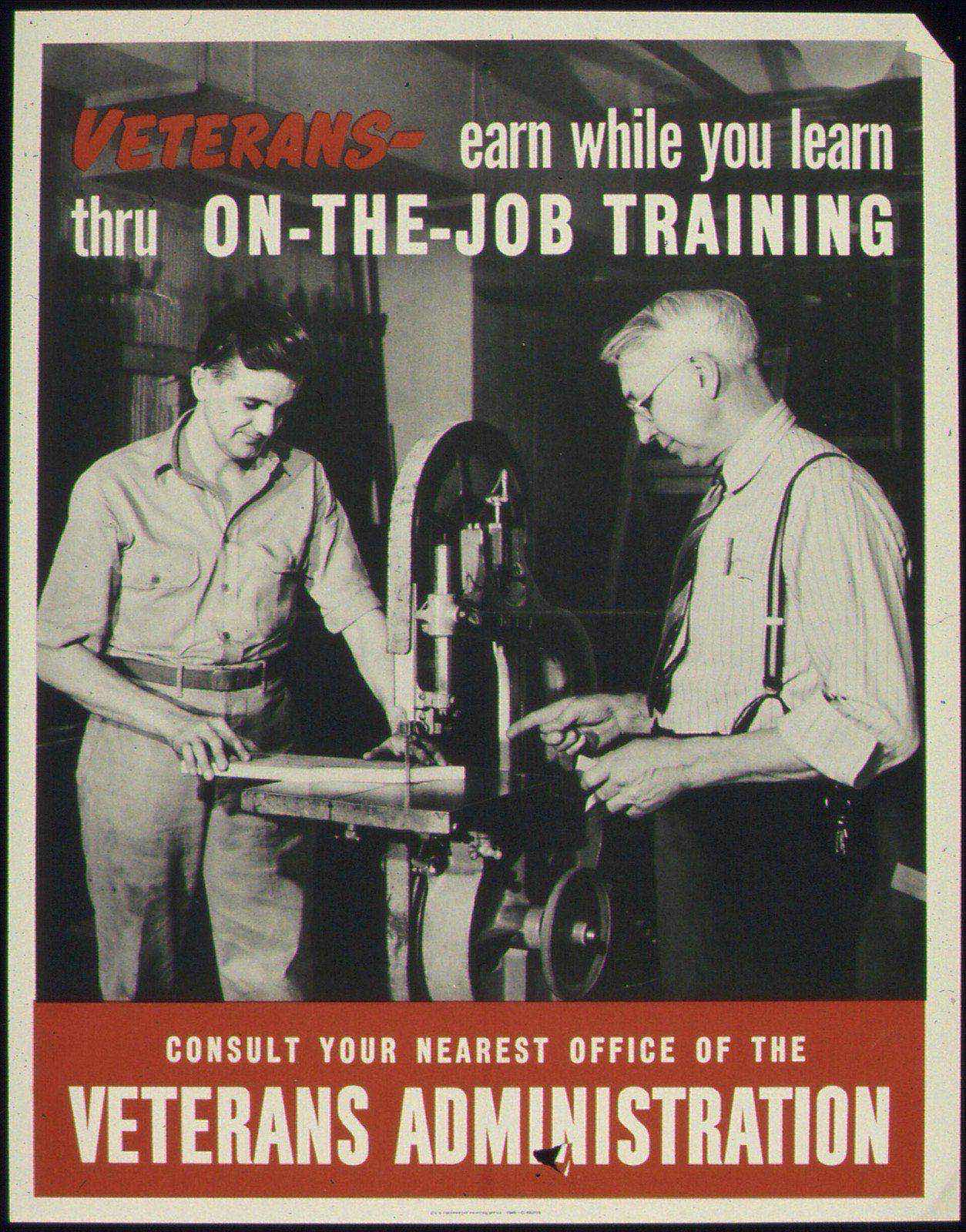 U.S. Veterans Administration poster, via U.S. National Archives.
Where it stands, November 16, 2026: the House passed H.R. 9237 by voice vote on November 11, 2026. The Senate has not voted. It is not law, and nothing about your rating, your check or your care has changed because of it. Vegas Veteran Voices takes no side on this bill. This is what it says, and what people on each side say it means. Latest status
Eighty becomes a hundred. That is the whole section. It is two lines long, and you would need the old law open in the next tab to know what it does.
The short answer
Yes, for one stretch of the program. Section 210 would raise the housing stipend for a full-time apprenticeship or on-the-job training (OJT) under the Post-9/11 GI Bill. In the second six months it goes from 80 percent to 100 percent of the housing-allowance amount. Every other month stays where it is. The bill is not law, so nothing has changed yet.
Post-9/11 GI Bill is the education benefit for people who served after September 10, 2001. OJT means you are paid to learn on the job instead of sitting in a classroom. Apprenticeships are the same idea with a structured program behind them.
Where to see it in the bill
- Section 210. House version: Congressional Record, July 16, 2026, page H4563. Introduced text: page 134, lines 13 to 24. The two versions are identical.
- The line that does it: “in clause (i)(II), by striking ‘80 percent’ and inserting ‘100 percent’.” That is all the text says. It never names months 7 through 12.
- What the clause is: the existing statute, 38 U.S.C. 3313(g)(3)(B)(i), which we read at Cornell’s Legal Information Institute. The page shows the second-period line as “during the second six-month period of the program, 80 percent.”
- The section title says “first year.” With months 1 to 6 already at 100 percent, the whole first year would pay the full rate.
Today versus the bill
The stipend is a percentage of the basic allowance for housing (BAH), which is the military housing pay for an E-5 with dependents in the area around the employer’s ZIP code. VA’s rates page puts it this way: “We’ll pay you a percentage of the full BAH rate based on how many months you’ve been training in your program:” and the first line of its list is “Months 1 to 6: 100% of the full BAH rate.” The schedule in the statute:
| Period of the program | Today | Under Section 210 |
|---|---|---|
| Months 1 to 6 | 100 percent | 100 percent |
| Months 7 to 12 | 80 percent | 100 percent |
| Months 13 to 18 | 60 percent | 60 percent |
| Months 19 to 24 | 40 percent | 40 percent |
| After month 24 | 20 percent | 20 percent |
In plain terms: two existing rules still apply, so your check may be smaller than the table shows. Two more pieces of current law ride along, and the bill does not touch them. A month with fewer than 120 hours of training is paid in proportion to the hours worked, rounded to the nearest eight. And Veterans entitled at the reduced Post-9/11 benefit tiers have that reduced percentage applied to these amounts too.
The bill also adds the words “using educational assistance under this chapter” to the lead-in for this part of the statute. We read that as pinning the schedule to Post-9/11 benefits only.
What it means
- What changes. Months 7 through 12 would pay a quarter more than they do now, because 100 is a quarter bigger than 80. We are not putting dollar figures on it. The amount depends on the employer’s ZIP code, the Veteran’s benefit tier and the hours worked.
- For whom. Veterans in a full-time, Post-9/11 apprenticeship or OJT program who reach month 7. VA’s OJT page adds one limit: “You can’t get on-the-job training if you’re an active-duty service member.”
- Starting when. The text has no start date of its own.
- What stays the same. Year two and beyond keep the steep step-down. That is the part of the schedule the bill leaves alone.
Who it helps
Veterans in a full-time, Post-9/11 apprenticeship or OJT program who reach month 7. Nobody else is touched by this section. Nothing in the bill says how many people that is.
The Department of Labor describes these programs as “earn-and-learn programs” that “provide Veterans with the ability to learn a new skill without accumulating college debt.” Stars and Stripes, in its June 16 rundown of the 62 bills inside the package, wrote that the bill “eliminates GI Bill provisions that result in financial disadvantages for Veterans choosing apprenticeships.” That is the paper’s description. The bill’s own words are the two lines above.
What we don’t know yet
- Cost. The bill states none, and we found no Congressional Budget Office score for the package.
- Whether the Senate keeps it. None of the statements we have on file speaks to this section.
- Whether Congress will later look at the other steps in the schedule. This bill does not.
What Veterans told us
Evelyn Pacheco, a U.S. Army Veteran and Nevada’s first Black female union plumber, was talking about the trades, not this bill, and we don’t know whether she used the GI Bill. Here is what she said about the work itself:
“Women need to be in these apprenticeships. They need to make money.”
Where to go from here
For anything about your own claim, rating or benefits, talk to free accredited help. Listings are not an endorsement.
- Veterans Service Officers, VAST Las Vegas (Nevada Department of Veterans Services). Free, state-employed service officers who help Veterans file and follow VA claims in Las Vegas.
- Find a VA-accredited representative. VA’s own search for free accredited help, by ZIP code.
- H.R. 9237 on Congress.gov. The bill’s official page: text, every action and its status.
If you are a Veteran in crisis or having thoughts of suicide, call 988 and press 1, or text 838255. The Veterans Crisis Line is free and confidential, 24 hours a day.
More on H.R. 9237
Start at the full guide to H.R. 9237.
Ratings and claims: Will H.R. 9237 cut sleep apnea ratings? · Will H.R. 9237 cut tinnitus ratings? · I’m already rated. What happens to me under H.R. 9237? · What does the October 1, 2026 date in H.R. 9237 mean for my claim? · Does H.R. 9237 change PTSD or other VA ratings? · Is H.R. 9237 a $57 billion cut to Veterans’ benefits? · Can VA deny my claim for missing a C&P exam under H.R. 9237? · What does H.R. 9237 change about VA appeals? · What does H.R. 9237 change about C&P exams? · Will H.R. 9237 make VA letters and forms easier to read? · What does H.R. 9237 change for MST claims?
Money, survivors and home loans: What does H.R. 9237 do with the Major Richard Star Act? · TCAVA’s Star Act vs the standalone Star Act: what’s the difference? · Can surviving spouses remarry without losing benefits under H.R. 9237? · What does H.R. 9237 change for DIC and ALS survivors? · What is the $833.33 a month in H.R. 9237? · Does H.R. 9237 raise VA home loan fees? · Can Guard and Reserve get a VA home loan under H.R. 9237?
School, jobs and getting out: What does H.R. 9237 change about the GI Bill? · What does H.R. 9237 change about TAP and SkillBridge?
Mental health and care: What does H.R. 9237 do to the Fox suicide prevention grants? · What are the mental health care grants in H.R. 9237? · Will H.R. 9237 make it easier to get into VA residential treatment? · Can VA prescribe controlled medications by telehealth under H.R. 9237? · What does H.R. 9237 do about opioid overdoses? · Does H.R. 9237 pay for service dogs? · What does H.R. 9237 do for TBI and blast exposure? · What does H.R. 9237 do for caregivers? · What does H.R. 9237 change about how Veteran deaths are counted? · What does H.R. 9237 do for women Veterans? · What does H.R. 9237 do for Veterans with spinal cord injuries? · What does H.R. 9237 do for prosthetics, adaptive sports and car adaptations? · Does H.R. 9237 study the children of toxic-exposed Veterans?
The VA system: What does H.R. 9237 change about community care? · Does H.R. 9237 privatize the VA? · What does H.R. 9237 do for rural Veterans? · What does H.R. 9237 change for Veterans on VA and Medicare? · Which new VA hospitals are in H.R. 9237? · What does H.R. 9237 mean for VA staff? · Will H.R. 9237 fix VA scheduling and phone calls? · What does H.R. 9237 change for burial benefits and headstones?
The politics: Why are Veteran groups split on H.R. 9237? · Where does H.R. 9237 stand, and what happens next? · Why was H.R. 9237 passed by voice vote?