

What does H.R. 9237 do with the Major Richard Star Act?
Combat-injured medical retirees would draw both retired pay and VA disability. Read pages 8 and 9 before you do the math: the package version has a cap.
By Vegas Veteran Voices,
From Why SERE Breaks People | Marine Recon Instructor Explains Survival Training
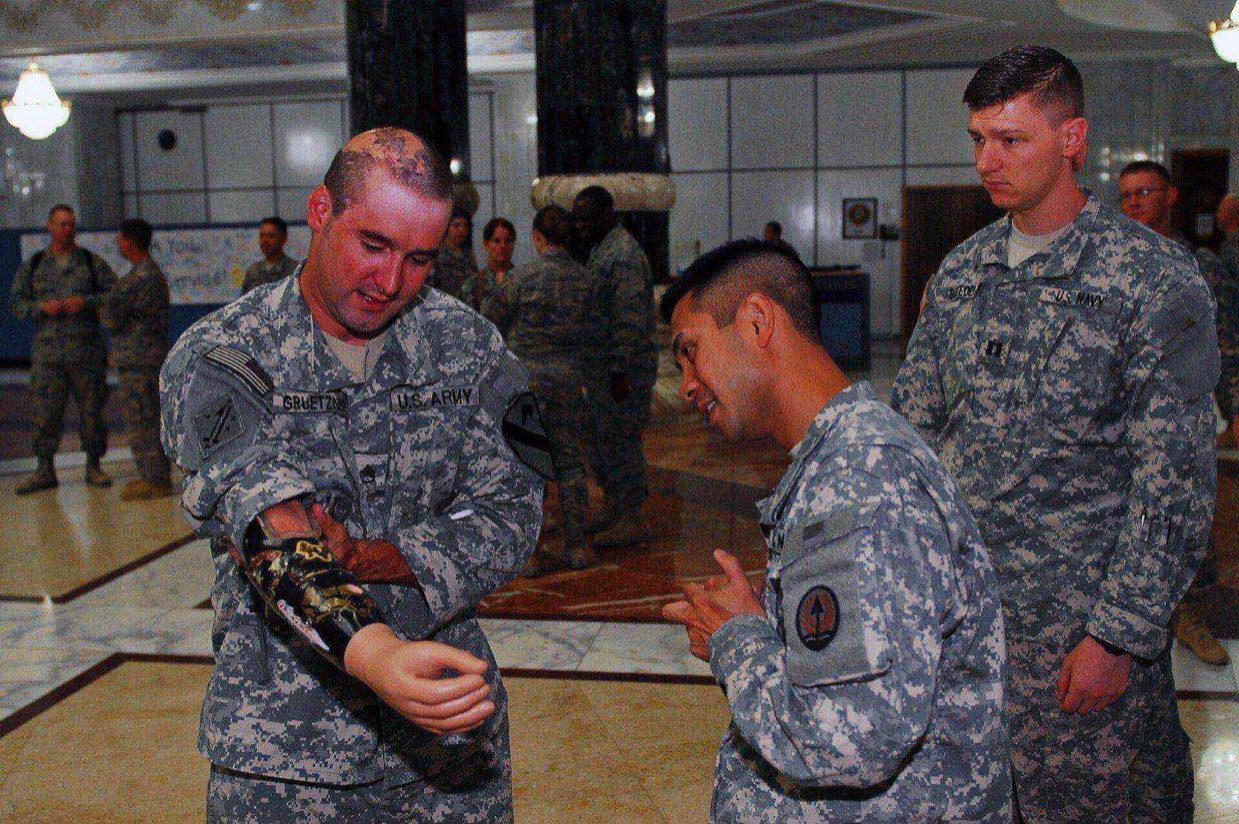 Photo by Staff Sgt. Luke Koladish, via DVIDS (DVIDS image 181963). File photo; the people shown are not connected to this bill.
Where it stands, November 16, 2026: the House passed H.R. 9237 by voice vote on November 11, 2026. The Senate has not voted. It is not law, and nothing about your rating, your check or your care has changed because of it. Vegas Veteran Voices takes no side on this bill. This is what it says, and what people on each side say it means. Latest status
Picture it. An IED ends your career at year eight. The military medically retires you, and VA rates your injuries. Two different checks, earned two different ways. For decades the law has said: pick one. That is the offset the Star Act would end. The version inside H.R. 9237 would end it with an asterisk.
The short answer
Section 101 of H.R. 9237 is a version of the Major Richard Star Act. It would let members retired under Chapter 61 with a combat-related disability receive military retired pay and VA disability compensation together, instead of having one reduce the other. Chapter 61 is the part of Title 10 of the U.S. Code that covers retirement for medical reasons. Drawing both checks at once is called concurrent receipt. For those with fewer than 20 years, the bill pays “the lesser of” two amounts, which works as a cap. The standalone Star Act, without the cap, is a separate bill.
The problem it fixes
Today, a medically retired service member with fewer than 20 years generally has military retired pay offset, dollar for dollar, by VA disability compensation. Offset means one check is reduced by the amount of the other. Retirees with 20 or more years got relief from this years ago. Those pushed out early by injury did not get that relief.
The bill is named for Maj. Richard Star, an Army Reserve combat engineer who pushed for this fix and died of lung cancer on February 13, 2021; he and his family tied the cancer to burn pit exposure (Military Officers Association of America (MOAA)).
Where to see it in the bill
- Section 101, “Major Richard Star Act.” House version: Congressional Record, July 16, 2026, page H4550. Introduced text: starts page 6, line 2.
- The “lesser of” formula: introduced page 8, lines 13 to 14, through page 9, line 9.
- Combat-related only: introduced page 9, lines 10 to 18. Non-combat Chapter 61 retirees are left out.
- Start date: House version, “payments for months beginning on or after the date of the enactment” (Record page H4550). The introduced text said January 1, 2027 (page 11, lines 1 to 4).
What “the lesser of” means
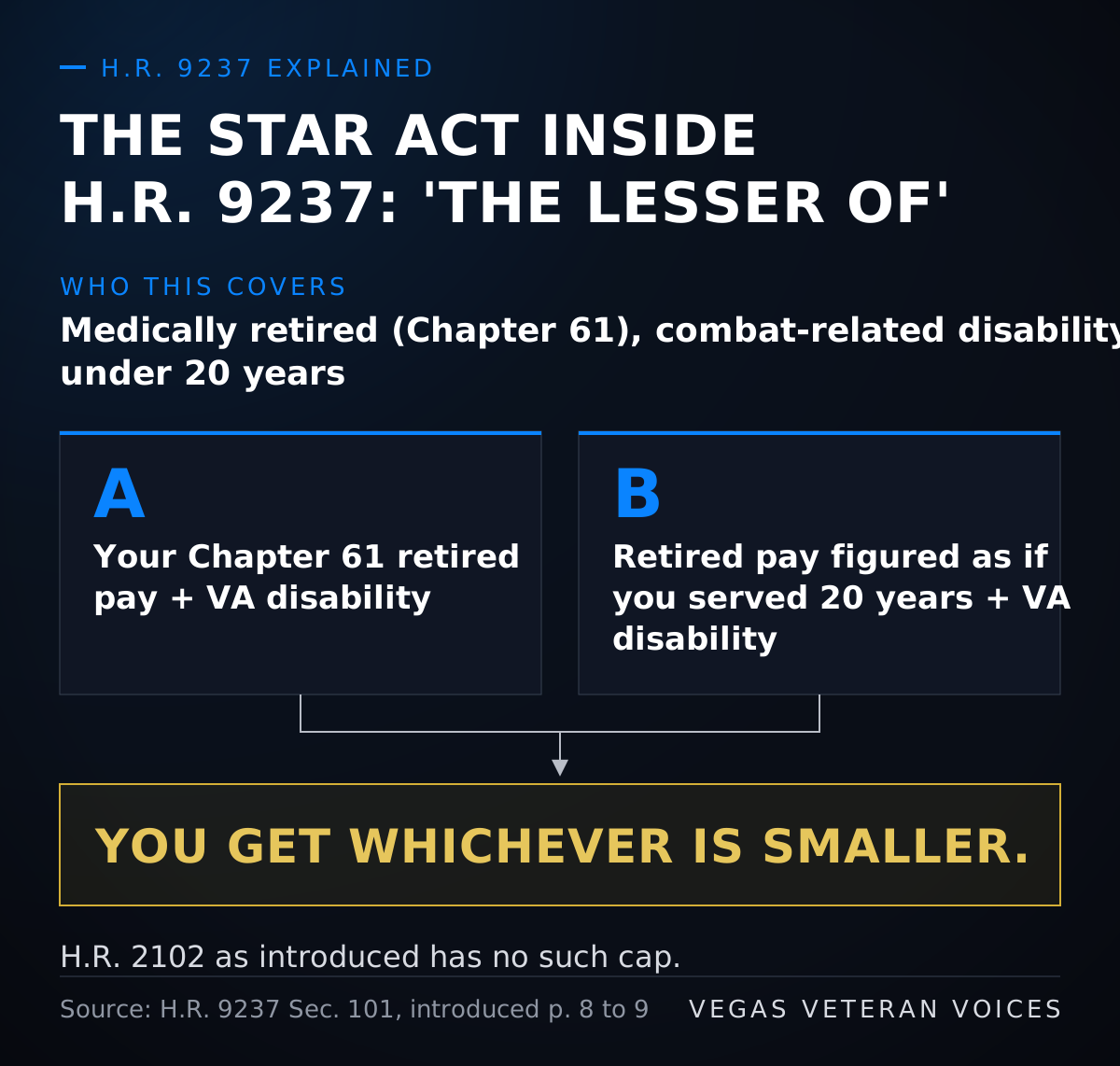
For a combat-injured Chapter 61 retiree with under 20 years, the bill says the member may receive “the lesser of”:
- their Chapter 61 retired pay plus VA disability compensation, or
- retired pay figured “as if the member had 20 years of service,” plus VA disability compensation.
So you get whichever of those two is smaller. If your medical retirement pay is figured from your disability percentage and comes out higher than what 20 years of service would pay, the bill gives you the 20-year figure. Rep. Raul Ruiz, as reported by Government Executive, called the package version watered down compared with the standalone bill because of this cap (GovExec, June 25, 2026). Supporters describe it as keeping a medical retiree from out-earning a 20-year retiree.
Whether you’d come out ahead, and by how much, depends on your own retired pay and rating. That’s a calculation for your retirement services office or an accredited service officer.
What changes, for whom, starting when. If the bill becomes law as the House wrote it, combat-injured Chapter 61 retirees with under 20 years would stop having retired pay reduced dollar for dollar, up to the cap. The House version starts with months beginning on or after the date the bill becomes law. What stays the same: Veterans retired for medical reasons without a combat link are not covered by this section.
How many people
About 54,000, according to Military.com’s reporting: the bill “would allow approximately 54,000 combat-injured military retirees to receive both their full military retirement pay” and VA disability pay (Military.com). Wounded Warrior Project says “Nearly 60,000 combat-injured Veterans are forced to forfeit a portion of their retirement pay” (WWP). Stars and Stripes reported “roughly 60,000 combat-wounded Veterans will be allowed to collect their full military retirement pay” (Stars and Stripes, November 9). The numbers differ because the sources count differently.
Who backs it, and what they say
- MOAA, which supports the package, says the bill includes “the Major Richard Star Act, which provides meaningful relief to combat-injured Chapter 61 retirees” (MOAA, June 26, 2026).
- Wounded Warrior Project says “The Major Richard Star Act, included in this bill, would finally address this unjust offset.”
- Roll Call wrote that the standalone bill “has been a top priority for Veterans groups and has ample bipartisan support” (Roll Call, September 16, 2026).
The standalone Star Act is a different bill
The clean version is H.R. 2102 in the House and S. 1032 in the Senate. As of early November it had about 341 House cosponsors and 80 in the Senate (Stars and Stripes, November 9, linked above).
- A discharge petition to force a House vote on it reached 218 signatures on September 16, 2026 (Roll Call). A discharge petition lets a majority of the House pull a bill to the floor over leadership’s objection.
- On November 11 the House voted 245 to 175 on the discharge motion, then postponed further action (Military.com). The House then passed the standalone bill on November 12, 2026: govinfo now lists H.R. 2102 as engrossed in the House. Engrossed means it is the final text the House passed. Government Executive reported “The Star Act passed by a 392-18 vote” (GovExec, November 2026). So two versions of the Star Act are now waiting in the Senate, with and without the cap. See the status page.
- The standalone bill has been blocked from quick Senate passage before. Then-Legion National Commander Dan Wiley said in August that “politically, the votes aren’t there to get it through the Senate” (Legion). That is the Legion’s main argument for the package.
What Veterans told us
The Star Act is written for people pushed out by combat injuries. We don’t know whether any of our guests would qualify; the rules and their records decide that. What they can tell you is what a medical retirement felt like.
Jason Brooks, a medically retired U.S. Marine and former Recon and SERE instructor, hurt in Iraq in 2003:
“I was medically retired. I didn’t want to get out. I mean, that hurt me more than most things I’ve been through.”
Alfred Brenner, a U.S. Marine dog handler and Purple Heart recipient, medically retired after an IED:
“Looking back, I wish I stayed in. I would have been retired by now.”
What we don’t know yet
- Whether the Senate keeps the cap, takes up the standalone bill, both or neither.
- The final start date.
- The cost: we found no Congressional Budget Office score for the package version as of November 15.
Where to go from here
For anything about your own claim, rating or benefits, talk to free accredited help. Listings are not an endorsement.
- Veterans Service Officers, VAST Las Vegas (Nevada Department of Veterans Services). Free, state-employed service officers who help Veterans file and follow VA claims in Las Vegas.
- Find a VA-accredited representative. VA’s own search for free accredited help, by ZIP code.
- H.R. 9237 on Congress.gov. The bill’s official page: text, every action and its status.
If you are a Veteran in crisis or having thoughts of suicide, call 988 and press 1, or text 838255. The Veterans Crisis Line is free and confidential, 24 hours a day.
More on H.R. 9237
Start at the full guide to H.R. 9237.
Ratings and claims: Will H.R. 9237 cut sleep apnea ratings? · Will H.R. 9237 cut tinnitus ratings? · I’m already rated. What happens to me under H.R. 9237? · What does the October 1, 2026 date in H.R. 9237 mean for my claim? · Does H.R. 9237 change PTSD or other VA ratings? · Is H.R. 9237 a $57 billion cut to Veterans’ benefits? · Can VA deny my claim for missing a C&P exam under H.R. 9237? · What does H.R. 9237 change about VA appeals? · What does H.R. 9237 change about C&P exams? · Will H.R. 9237 make VA letters and forms easier to read? · What does H.R. 9237 change for MST claims?
Money, survivors and home loans: TCAVA’s Star Act vs the standalone Star Act: what’s the difference? · Can surviving spouses remarry without losing benefits under H.R. 9237? · What does H.R. 9237 change for DIC and ALS survivors? · What is the $833.33 a month in H.R. 9237? · Does H.R. 9237 raise VA home loan fees? · Can Guard and Reserve get a VA home loan under H.R. 9237?
School, jobs and getting out: What does H.R. 9237 change about the GI Bill? · Does H.R. 9237 raise GI Bill apprenticeship pay? · What does H.R. 9237 change about TAP and SkillBridge?
Mental health and care: What does H.R. 9237 do to the Fox suicide prevention grants? · What are the mental health care grants in H.R. 9237? · Will H.R. 9237 make it easier to get into VA residential treatment? · Can VA prescribe controlled medications by telehealth under H.R. 9237? · What does H.R. 9237 do about opioid overdoses? · Does H.R. 9237 pay for service dogs? · What does H.R. 9237 do for TBI and blast exposure? · What does H.R. 9237 do for caregivers? · What does H.R. 9237 change about how Veteran deaths are counted? · What does H.R. 9237 do for women Veterans? · What does H.R. 9237 do for Veterans with spinal cord injuries? · What does H.R. 9237 do for prosthetics, adaptive sports and car adaptations? · Does H.R. 9237 study the children of toxic-exposed Veterans?
The VA system: What does H.R. 9237 change about community care? · Does H.R. 9237 privatize the VA? · What does H.R. 9237 do for rural Veterans? · What does H.R. 9237 change for Veterans on VA and Medicare? · Which new VA hospitals are in H.R. 9237? · What does H.R. 9237 mean for VA staff? · Will H.R. 9237 fix VA scheduling and phone calls? · What does H.R. 9237 change for burial benefits and headstones?
The politics: Why are Veteran groups split on H.R. 9237? · Where does H.R. 9237 stand, and what happens next? · Why was H.R. 9237 passed by voice vote?