
Is H.R. 9237 a $57 billion cut to Veterans' benefits?
The $57 billion is the VFW's number, from a VA analysis. A Senate committee summary says $38 billion. We found no budget office score. Here's where each number comes from and what the bill says about the money.
By Vegas Veteran Voices,
The $57 billion is the VFW’s (Veterans of Foreign Wars) number, from a VA analysis. A Senate committee summary says $38 billion. We found no budget office score. Here’s where each number comes from and what the bill says about the money.
By Vegas Veteran Voices
Where it stands, November 16, 2026: the House passed H.R. 9237 by voice vote on November 11, 2026. The Senate has not voted. It is not law, and nothing about your rating, your check or your care has changed because of it. Vegas Veteran Voices takes no side on this bill. This is what it says, and what people on each side say it means. Latest status
Everybody in this fight has a number. Nobody has handed us the spreadsheet.
The short answer
Nobody has shown us a Congressional Budget Office score for this package. The CBO is the office Congress uses to price bills. We looked and found none.
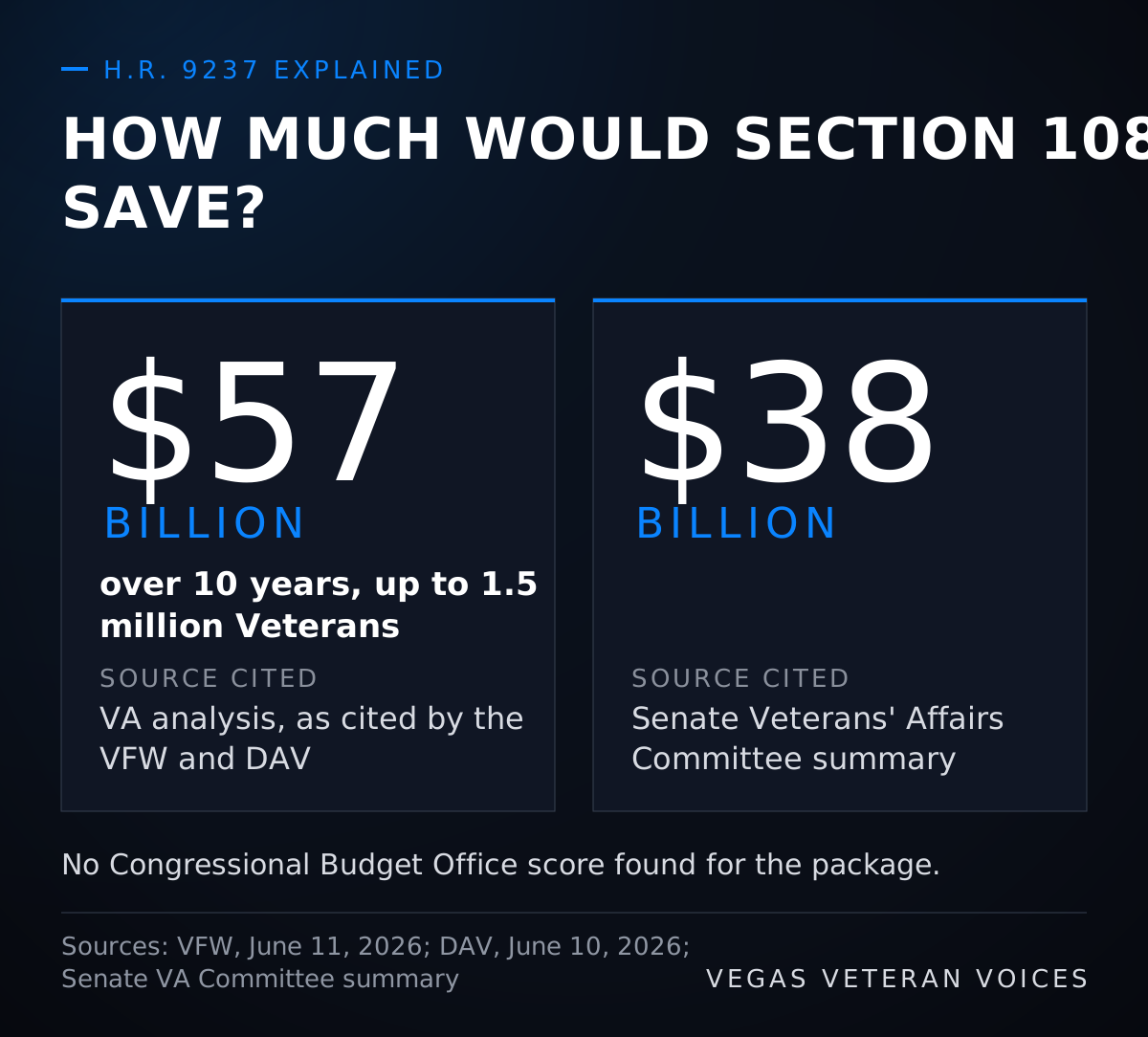
What exists is three numbers from three sources, and they don’t match. About $57 billion over ten years, affecting up to 1.5 million Veterans, is the figure the VFW and DAV (Disabled American Veterans) cite from an internal VA analysis. $38 billion is from a Senate Veterans’ Affairs Committee summary. Democrats at a June press conference said the package attaches “$60 billion in cuts to other Veterans’ benefits,” as Government Executive reported.
The first two are described as savings from Section 108. That is the section that writes new rating rules for sleep apnea and tinnitus into law. Whether you call savings a “cut” depends on what you measure against, and the people fighting about it measure differently.
Where to see it in the bill
- Section 108, the rating changes. House version: Congressional Record, July 16, 2026, page H4555. Introduced text: pages 59 to 61. Protection for current ratings: Section 108(c)(2), same words in both versions.
- No savings figure. We searched the House text for “savings,” “offset” and “Treasury.” No clause states a savings total for Section 108 or sends those savings to a particular program.
- The dollar lines the bill does state, below.
- The rules today. Tinnitus is listed as “6260 Tinnitus, recurrent,” rated 10 percent. Sleep apnea at the 50 percent level is for someone who “Requires use of breathing assistance device such as continuous airway pressure (CPAP) machine.” (continuous positive airway pressure) Our pages on sleep apnea and tinnitus cover what the bill would change.
What it says
Where each number comes from
| Number | Who published it | What we could and couldn’t check |
|---|---|---|
| About $57 billion over ten years; up to 1.5 million Veterans | The VFW (June 11, 2026) and DAV (June 10 headline), citing VA estimates | Not a CBO score. We did not see the VA analysis itself. |
| $38 billion over ten years | A Senate Veterans’ Affairs Committee summary, as reported by Newsweek and WMAR | We could not open the summary. Newsweek’s article, which we opened, quotes it. |
| $60 billion | Democrats at a press conference, as reported by Government Executive | A political claim in a news story. No math shown. |
| A CBO score | Nobody that we found | None located as of November 15. |
Newsweek wrote that the Senate committee summary says the changes would “reduce future federal spending by $38 billion over 10 years.” The same story says the VFW estimate “could reduce future compensation by approximately $57 billion over 10 years.” Other sources: WMAR, VFW, June 11, DAV, June 10. DAV’s National Commander Coleman Nee said the changes “could cut benefits for up to 1.5 million Veterans.”
We don’t know why the figures differ. They may count different things or different years. We haven’t seen anyone’s math.
Dollar lines the House version does state
| Item | Amount | Where |
|---|---|---|
| Information technology funds, “authorized to be appropriated, and there is appropriated” | $500,000,000 for fiscal year 2026 | Record H4582; introduced page 323 |
| Major medical facility, Manchester, New Hampshire | $1,180,000,000 | Record H4580; introduced page 315 |
| Major medical facility, Indianapolis (added in the House version) | $1,641,570,000 | Record H4581 |
| Land for a new facility, San Antonio (added in the House version) | $30,000,000 | Record H4581 |
The bill states no cost for the Star Act, the $833.33 allowance or the survivor raises. Those are real money with no number attached.
What it means
Section 108 protects “compensation that was in effect on the day before the date of the enactment.” So nobody’s current check is the thing being counted. The VFW’s July alert says so itself: “While current disability ratings would be protected, future Veterans with service-connected disabilities could receive less compensation than they otherwise would have under current law” (VFW, July 15, 2026). The big number is money that would not go to future claimants, compared with today’s rules.
That is a real amount. It is also a different thing from reaching into a Veteran’s pocket today. Both sentences are true. Which one gets the headline depends on who writes it.
Ten-year budget numbers are a lot like a PowerPoint slide in a mission brief. Bold, rounded, and nobody has ever seen the spreadsheet.
What it could mean
- The VFW, Carol Whitmore, then National Commander: “A grateful nation pays its debts to Veterans; it does not send them the invoice” (VFW, June 11). In November, Commander-in-Chief Cory Geisler said “Veterans’ earned benefits should never be used as a congressional piggy bank,” and “We must honor the contract, not rewrite it when the bill comes due” (VFW, November 11, 2026).
- DAV calls the provision a “poison pill” inside a larger package (DAV, June 10).
- The American Legion says “VA/OMB will make rating changes by regulation regardless of what happens to TCAVA,” (OMB is the White House budget office) (the bill’s initials) and “The question is whether those savings will support Veterans programs or be lost to the Treasury” (Legion, Dan K. Wiley, July 17). OMB is the White House budget office. TCAVA is the bill’s initials.
- MOAA (Military Officers Association of America) supports the bill on balance and says it “represents a net expansion of benefits and support for Veterans” (MOAA, June 26, 2026).
What we don’t know yet
- A CBO score, if one is ever published.
- Whether the $57 billion and $38 billion count only sleep apnea and tinnitus.
- Where the savings would go. We found no clause in the bill text that says.
- Whether the Senate changes Section 108, or its dates.
Where to go from here
For anything about your own claim, rating or benefits, talk to free accredited help. Listings are not an endorsement.
- Veterans Service Officers, VAST Las Vegas (Nevada Department of Veterans Services). Free, state-employed service officers who help Veterans file and follow VA claims in Las Vegas.
- Find a VA-accredited representative. VA’s own search for free accredited help, by ZIP code.
- H.R. 9237 on Congress.gov. The bill’s official page: text, every action and its status.
If you are a Veteran in crisis or having thoughts of suicide, call 988 and press 1, or text 838255. The Veterans Crisis Line is free and confidential, 24 hours a day.
More on H.R. 9237
Start at the full guide to H.R. 9237.
Ratings and claims: Will H.R. 9237 cut sleep apnea ratings? · Will H.R. 9237 cut tinnitus ratings? · I’m already rated. What happens to me under H.R. 9237? · What does the October 1, 2026 date in H.R. 9237 mean for my claim? · Does H.R. 9237 change PTSD or other VA ratings? · Can VA deny my claim for missing a C&P exam under H.R. 9237? · What does H.R. 9237 change about VA appeals? · What does H.R. 9237 change about C&P exams? · Will H.R. 9237 make VA letters and forms easier to read? · What does H.R. 9237 change for MST claims?
Money, survivors and home loans: What does H.R. 9237 do with the Major Richard Star Act? · TCAVA’s Star Act vs the standalone Star Act: what’s the difference? · Can surviving spouses remarry without losing benefits under H.R. 9237? · What does H.R. 9237 change for DIC and ALS survivors? · What is the $833.33 a month in H.R. 9237? · Does H.R. 9237 raise VA home loan fees? · Can Guard and Reserve get a VA home loan under H.R. 9237?
School, jobs and getting out: What does H.R. 9237 change about the GI Bill? · Does H.R. 9237 raise GI Bill apprenticeship pay? · What does H.R. 9237 change about TAP and SkillBridge?
Mental health and care: What does H.R. 9237 do to the Fox suicide prevention grants? · What are the mental health care grants in H.R. 9237? · Will H.R. 9237 make it easier to get into VA residential treatment? · Can VA prescribe controlled medications by telehealth under H.R. 9237? · What does H.R. 9237 do about opioid overdoses? · Does H.R. 9237 pay for service dogs? · What does H.R. 9237 do for TBI and blast exposure? · What does H.R. 9237 do for caregivers? · What does H.R. 9237 change about how Veteran deaths are counted? · What does H.R. 9237 do for women Veterans? · What does H.R. 9237 do for Veterans with spinal cord injuries? · What does H.R. 9237 do for prosthetics, adaptive sports and car adaptations? · Does H.R. 9237 study the children of toxic-exposed Veterans?
The VA system: What does H.R. 9237 change about community care? · Does H.R. 9237 privatize the VA? · What does H.R. 9237 do for rural Veterans? · What does H.R. 9237 change for Veterans on VA and Medicare? · Which new VA hospitals are in H.R. 9237? · What does H.R. 9237 mean for VA staff? · Will H.R. 9237 fix VA scheduling and phone calls? · What does H.R. 9237 change for burial benefits and headstones?
The politics: Why are Veteran groups split on H.R. 9237? · Where does H.R. 9237 stand, and what happens next? · Why was H.R. 9237 passed by voice vote?