

Will H.R. 9237 cut tinnitus ratings?
Tinnitus is the most common disability VA pays for. Section 108 would end the stand-alone 10% for most future claims. Here is the one sentence that does it.
By Vegas Veteran Voices,
 U.S. Air Force photo by Staff Sgt. Danielle Sukhlall.
Where it stands, November 16, 2026: the House passed H.R. 9237 by voice vote on November 11, 2026. The Senate has not voted. It is not law, and nothing about your rating, your check or your care has changed because of it. Vegas Veteran Voices takes no side on this bill. This is what it says, and what people on each side say it means. Latest status
If you spent your service next to jet engines, generators, gunfire or a flight deck, you may already have the ringing. It doesn’t turn off. VA rates more of it than any other condition. Section 108 of H.R. 9237 is one sentence long on tinnitus, and that sentence matters to a lot of people who haven’t filed yet.
The short answer
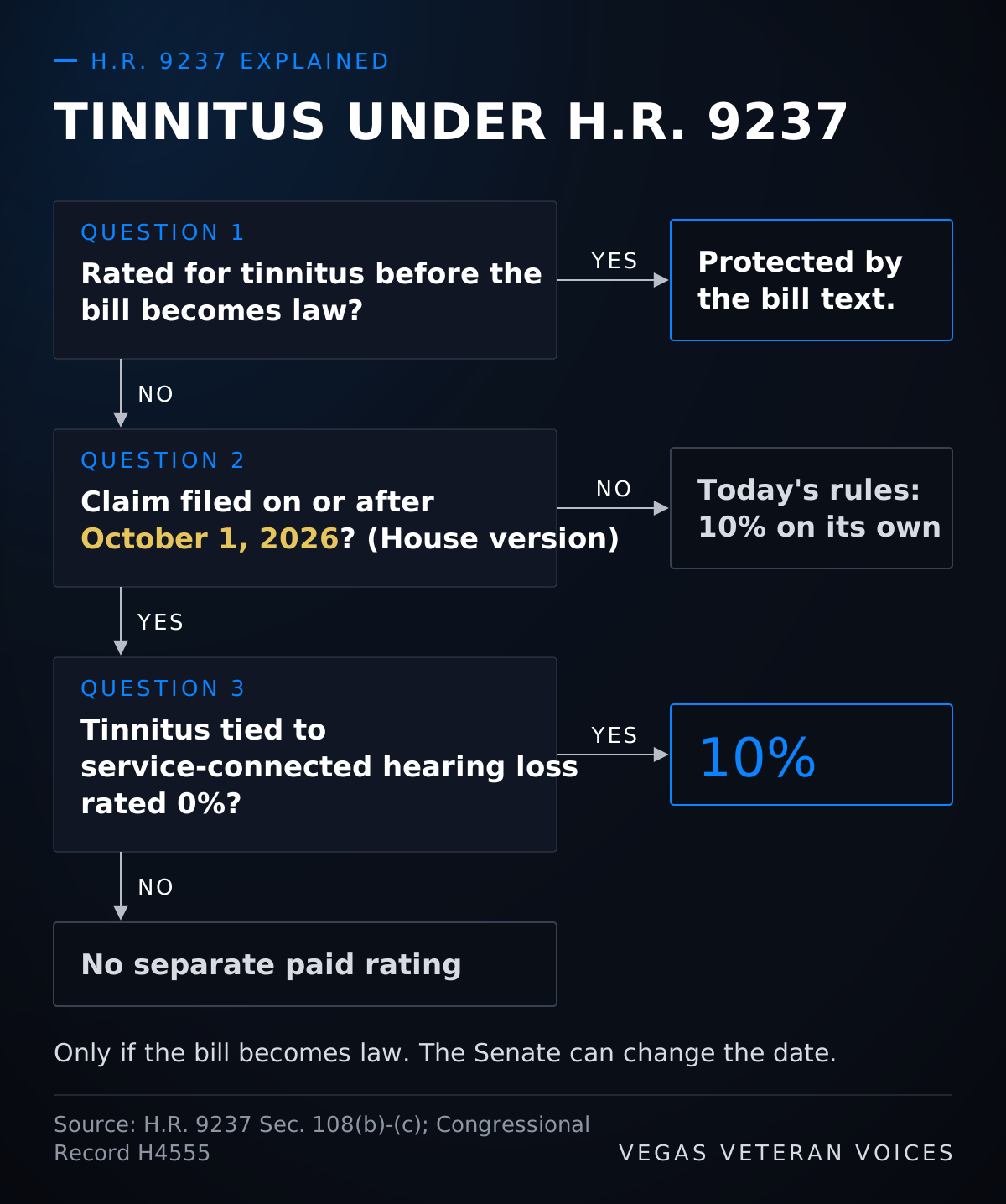
If you are rated for tinnitus today, the bill text protects that rating. For claims filed under the new rules, tinnitus could no longer be rated on its own. The only way to get 10% for it would be if it comes with service-connected hearing loss that is itself rated at zero. The bill is not law.
Where to see it in the bill
- Section 108(b), “Ratings for tinnitus.” House version: Congressional Record, July 16, 2026, page H4555. Introduced text: page 60, lines 15 to 23.
- The sentence: “tinnitus may not be assigned a separate compensable disability rating” (introduced page 60, lines 15 to 17).
- The exception: a 10% rating “shall be assigned for tinnitus only when tinnitus is diagnosed as associated with” service-connected hearing loss “that is otherwise noncompensable” (page 60, lines 18 to 23).
- Who it applies to and who is protected: Section 108(c), as explained in the sleep apnea breakdown. House version: claims filed on or after October 1, 2026.
Today versus the bill
Today, tinnitus that keeps coming back is rated 10%, once. The rule says to “Assign only a single evaluation for recurrent tinnitus, whether the sound is perceived in one ear, both ears, or in the head” (38 CFR 4.87, code 6260, Cornell Law, opened 2026-11-16). The table lists it as “6260 Tinnitus, recurrent | 10.” It can be rated on its own and combined with other ratings.
Under Section 108, tinnitus “may not be assigned a separate compensable disability rating.” A compensable rating is one that pays. The one exception: when tinnitus comes with service-connected hearing loss that is rated at zero, the tinnitus gets 10%.
How a claim gets decided is the other half. VA sends most claimants to a claim exam, and its own page says: “This exam will help us determine if you have a service-connected disability” (VA claim exam page, opened 2026-11-16). Tinnitus is something an examiner can’t measure on a screen. That is why the exam matters so much, and why our guests tell the stories below.
What it means
What changes: the ringing that never turns off stops being its own paid rating for most new claims. That includes Veterans whose hearing tests come back normal while the ringing doesn’t.
For whom: Veterans who file under the new rules. Ratings already in effect are protected by the text. The change would fall on Veterans who file later.
Starting when: claims filed on or after October 1, 2026 in the House version. The introduced text said after the date of enactment. The bill is not law yet, so that date is not final.
The money: in 2026, a 10% rating pays $180.42 a month, about $2,165 a year. VA’s rates page is titled “Review 2026 Veterans disability compensation rates” (VA rates, opened 2026-11-16). Ratings combine in VA math, so losing a separate 10% can also change a Veteran’s combined rating.
How common it is: VA’s FY2025 (fiscal year) Annual Benefits Report counts 3,583,295 service-connected tinnitus disabilities, more than any other condition (VA ABR).
What you don’t need to worry about: your existing rating, if you have one. The bill’s protection for compensation already in effect covers it. How VA would handle re-exams is one of the open questions; see I’m already rated. What happens to me?
What it could mean: what each side says
- Supporters describe tinnitus as a symptom usually tied to hearing loss and say the change matches VA’s own 2022 proposal, which would have rated tinnitus as part of the underlying condition. The American Legion says the savings would otherwise go to the Treasury instead of Veteran programs (Legion, July 17, 2026).
- Opponents say it cuts the next generation’s compensation to pay for this one’s benefits. IAVA’s (Iraq and Afghanistan Veterans of America) Jess Finucan told Government Executive, “Once Congress starts rewriting the disability ratings whenever it needs money, there’s no limit” (GovExec, June 25, 2026).
- DAV (Disabled American Veterans) says the changes would apply “to all new claims as well as any reassessments or reevaluations of existing claims” (DAV, June 10, 2026). Supporters point to the bill’s protection for compensation already in effect.
- The reporting. Stars and Stripes describes the dispute as “a plan by Congress to reduce future benefits for tinnitus and sleep apnea” (Stars and Stripes, July 1, 2026, opened 2026-11-16). A VA spokesman told Newsweek about the separate VA rating rules, “No changes are planned or imminent” (Newsweek, opened 2026-11-16).
What Veterans told us
Two of our guests described their own tinnitus claims, long before this bill. Both show how much rides on one exam.
“Cheeks” Aguillon, a U.S. Army Veteran and former chaplain assistant, on his examiner:
“I’m gonna put down that you have tinnitus only because I can’t prove that you don’t.”
Ross D. Bryant, a U.S. Army Veteran who leads UNLV Military and Veteran Services, spent 17 years on tanks.
“Ironically, the VA did not approve my tinnitus.”
Tommy Nutzmann, a retired U.S. Navy chief who opposes the bill:
“Section 108 specifically was going to take tinnitus and sleep apnea away from Veterans essentially.”
That is his reading. The text protects current ratings and changes the rules for new claims.
What we don’t know yet
- Which filing date the final law will use (October 1, 2026 in the House version).
- How VA would rate tinnitus tied to other conditions besides hearing loss, and how it would treat secondary claims.
- How VA would write the regulation.
Where to go from here
For anything about your own claim, rating or benefits, talk to free accredited help. Listings are not an endorsement.
- Veterans Service Officers, VAST Las Vegas (Nevada Department of Veterans Services). Free, state-employed service officers who help Veterans file and follow VA claims in Las Vegas.
- Find a VA-accredited representative. VA’s own search for free accredited help, by ZIP code.
- H.R. 9237 on Congress.gov. The bill’s official page: text, every action and its status.
If you are a Veteran in crisis or having thoughts of suicide, call 988 and press 1, or text 838255. The Veterans Crisis Line is free and confidential, 24 hours a day.
More on H.R. 9237
Start at the full guide to H.R. 9237.
Ratings and claims: Will H.R. 9237 cut sleep apnea ratings? · I’m already rated. What happens to me under H.R. 9237? · What does the October 1, 2026 date in H.R. 9237 mean for my claim? · Does H.R. 9237 change PTSD or other VA ratings? · Is H.R. 9237 a $57 billion cut to Veterans’ benefits? · Can VA deny my claim for missing a C&P exam under H.R. 9237? · What does H.R. 9237 change about VA appeals? · What does H.R. 9237 change about C&P exams? · Will H.R. 9237 make VA letters and forms easier to read? · What does H.R. 9237 change for MST claims?
Money, survivors and home loans: What does H.R. 9237 do with the Major Richard Star Act? · TCAVA’s Star Act vs the standalone Star Act: what’s the difference? · Can surviving spouses remarry without losing benefits under H.R. 9237? · What does H.R. 9237 change for DIC and ALS survivors? · What is the $833.33 a month in H.R. 9237? · Does H.R. 9237 raise VA home loan fees? · Can Guard and Reserve get a VA home loan under H.R. 9237?
School, jobs and getting out: What does H.R. 9237 change about the GI Bill? · Does H.R. 9237 raise GI Bill apprenticeship pay? · What does H.R. 9237 change about TAP and SkillBridge?
Mental health and care: What does H.R. 9237 do to the Fox suicide prevention grants? · What are the mental health care grants in H.R. 9237? · Will H.R. 9237 make it easier to get into VA residential treatment? · Can VA prescribe controlled medications by telehealth under H.R. 9237? · What does H.R. 9237 do about opioid overdoses? · Does H.R. 9237 pay for service dogs? · What does H.R. 9237 do for TBI and blast exposure? · What does H.R. 9237 do for caregivers? · What does H.R. 9237 change about how Veteran deaths are counted? · What does H.R. 9237 do for women Veterans? · What does H.R. 9237 do for Veterans with spinal cord injuries? · What does H.R. 9237 do for prosthetics, adaptive sports and car adaptations? · Does H.R. 9237 study the children of toxic-exposed Veterans?
The VA system: What does H.R. 9237 change about community care? · Does H.R. 9237 privatize the VA? · What does H.R. 9237 do for rural Veterans? · What does H.R. 9237 change for Veterans on VA and Medicare? · Which new VA hospitals are in H.R. 9237? · What does H.R. 9237 mean for VA staff? · Will H.R. 9237 fix VA scheduling and phone calls? · What does H.R. 9237 change for burial benefits and headstones?
The politics: Why are Veteran groups split on H.R. 9237? · Where does H.R. 9237 stand, and what happens next? · Why was H.R. 9237 passed by voice vote?