
What does H.R. 9237 do for TBI and blast exposure?
Research money, a task force and two reports. No new rating, no new benefit. If you spent a career next to breaching charges, here is what the bill actually funds.
By Vegas Veteran Voices,
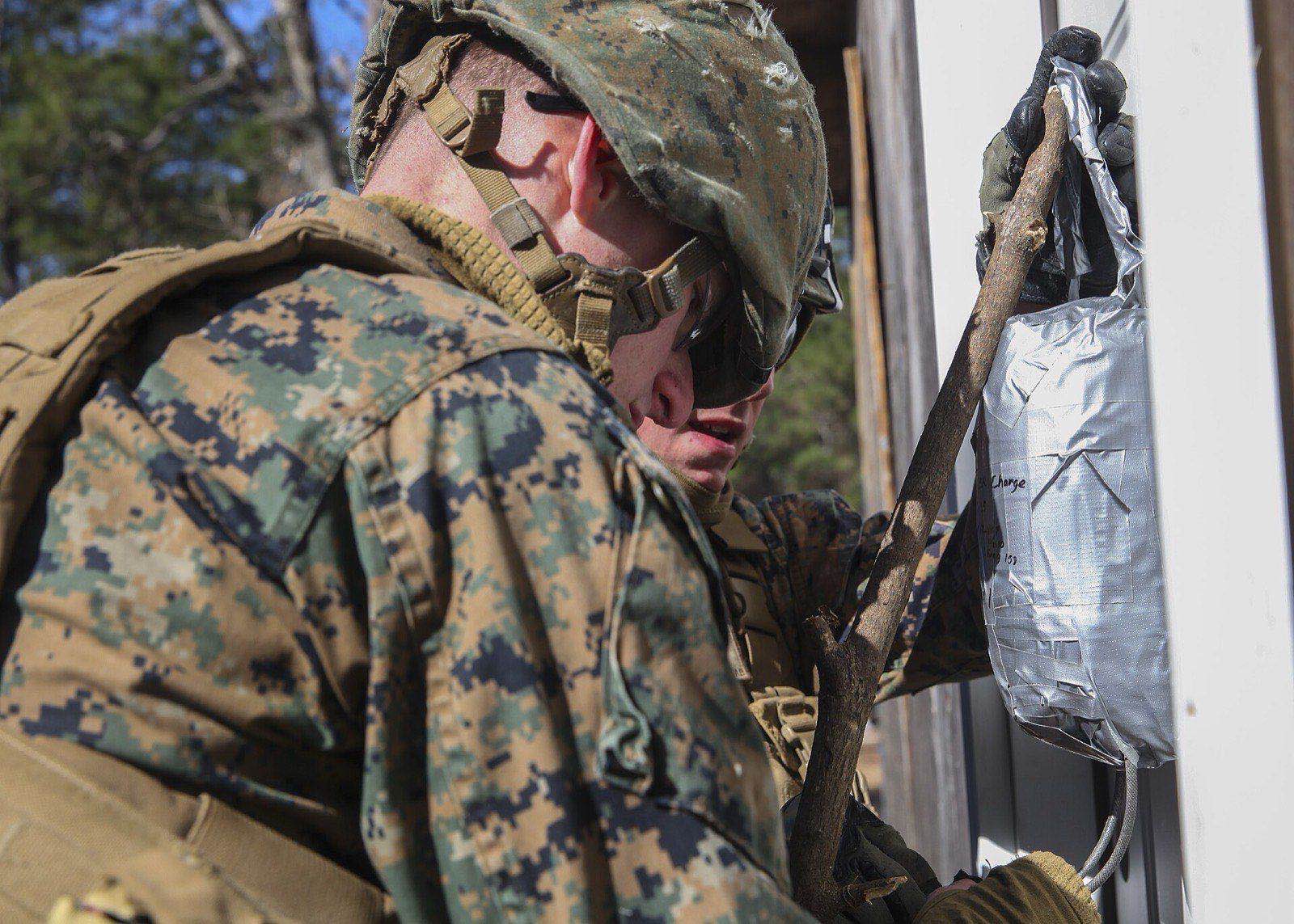 U.S. Marine Corps photo by Cpl. Michelle Reif.
Where it stands, November 16, 2026: the House passed H.R. 9237 by voice vote on November 11, 2026. The Senate has not voted. It is not law, and nothing about your rating, your check or your care has changed because of it. Vegas Veteran Voices takes no side on this bill. This is what it says, and what people on each side say it means. Latest status
Some of us took the hit and walked it off. Some of us stood next to the charge for years and never took one big hit at all. Science is only now catching up to the second group. This bill spends money on that gap. It does not hand anybody a check.
The short answer
Four sections cover it. All four are research, study and reporting. None changes a disability rating or gives a Veteran a new benefit.
- Section 303 sets up two grant programs for treatment research on chronic mild traumatic brain injury (TBI, damage to the brain from a blow or a blast).
- Section 311 creates a VA Blast Overpressure Task Force. Blast overpressure is the shock wave from an explosion or a heavy weapon firing.
- Section 310 widens VA’s Precision Medicine for Veterans Initiative to “repetitive low-level blast exposure.” Precision medicine means matching treatment to a person’s own biology.
- Section 307 orders a Government Accountability Office (GAO, the watchdog that works for Congress) update and a VA review on hyperbaric oxygen therapy, which is breathing pure oxygen in a pressurized chamber.
Where to see it in the bill
The House version matches the introduced text on all four, apart from one spelling-level fix.
| Section | House version (Congressional Record, July 16, 2026) | Introduced text |
|---|---|---|
| 303, TBI Innovation and research grants | pages H4564 to H4566 | pages 148 to 166 |
| 307, hyperbaric oxygen reports | page H4567 | pages 178 to 181 |
| 310, Precision Medicine and suicide-report data | pages H4568 to H4569 | pages 194 to 198 |
| 311, Blast Overpressure Task Force | page H4569 | pages 199 to 201 |
What VA says about TBI research today
VA’s research office says “VA research related to TBI is wide-ranging” (VA Research, opened 2026-11-16). VA also announced a new diagnostic code for blast brain injury. Its headline: “New ICD-10 diagnostic code will promote better care for Veterans with blast injuries to the brain” (VA News, opened 2026-11-16).
Section 303: two grant programs
The TBI Innovation Grant Program runs three years. It pays for “approaches and methodologies for prospective randomized control trials for neurorehabilitation treatments for the treatment of chronic mild traumatic brain injury” (introduced pages 148 to 149). A randomized trial is the kind where people are split into groups by chance so the results mean something. Nonprofits, universities, non-VA providers and partnerships can apply, capped at $5,000,000 per entity per year. “Chronic mild” means symptoms “that persist for not fewer than six months after the inciting injury.”
The research grant program runs through an independent organization. Each year VA awards “four grants for exploratory or pilot research,” up to $625,000 each, with “not fewer than three” to nonprofits. It also awards “five grants for collaborative or multidisciplinary” work, up to $1,500,000 each (page 159). Each program is authorized “$10,000,000 for each of fiscal years 2026 through 2028.” VA can’t require changes to a grantee’s study design except to meet human-subjects and patient-safety law.
Section 311: the task force
Within 180 days VA appoints the task force through the VA-Defense Joint Executive Committee. Its job is to improve how VA and Defense care for people “diagnosed with traumatic brain injury, post-traumatic stress disorder, or other symptoms, from blast overpressure or blast exposure.” It sets “physiological and cognitive performance baselines,” and prioritizes research on topics that include sleep therapy, vestibular dysfunction (balance and dizziness problems from the inner ear and brain), “cumulative mild traumatic brain injury” and neuroinflammation.
Its annual reports must recommend “how claims processors of the Department of Veterans Affairs should evaluate evidence that links such conditions to active military, naval, air, or space service,” and best practices for evaluating neurological injury in benefits exams (page 201, lines 3 to 20). It ends September 30, 2029.
Military.com reported on July 24, 2026 that a task force like this also rides in the defense bill, aimed at “improving how the VA provides health care and other benefits to Veterans” (Military.com, opened 2026-11-16). Military Times described the problem in plain terms in 2024: “Blast injuries occur when explosions create high-pressure waves that can damage sensitive organs like the ears and brain.” Sen. Jerry Moran said of a related bill that it “will help us start to better understand why and how blast exposures are impacting” Veterans (Military Times, December 9, 2024, opened 2026-11-16).
Section 310: precision medicine
The initiative’s scope widens to “repetitive low-level blast exposure, dementia, and such other brain and mental health conditions.” VA must set up a data-sharing partnership with Defense on blast exposure and brain injury. It must prioritize research to “identify and validate biomarkers,” which are measurable signs in the body that point to a condition. It must contract with the National Academies, the independent scientific advisers Congress uses, within 180 days. It can spend an authorized “$5,000,000” a year for fiscal years 2027 through 2032 (pages 194 to 198).
Section 307: hyperbaric oxygen
GAO updates its report “Research on Hyperbaric Oxygen Therapy to Treat Traumatic Brain Injury and Post-Traumatic Stress Disorder” within a year. VA does a “systematic review of published research literature on the off-label use of hyperbaric oxygen therapy” within 180 days, plus a market assessment of facilities. Off-label means using a treatment for something it was not approved for. Reports only.
What it means
What changes: federal money and a federal body aimed at brain injury and blast exposure. Nothing about your claim or your care changes.
For whom: researchers and clinics that win the grants, first. Veterans with chronic mild TBI could end up in the trials. Anyone exposed to repeated blast gets a federal body told to study it.
Starting when: the bill is not law. If it passes, the task force clock is 180 days from enactment.
What you don’t need to worry about: these sections do not recognize a condition or write a rating for blast exposure. The task force’s report on how claims processors should weigh evidence is the closest it gets to claims, and it is a recommendation to Congress, not a rule.
What we don’t know yet
- Whether the Senate keeps these sections. We found no Congressional Budget Office score.
- Whether appropriations follow. The authorization for Section 303 begins with fiscal year 2026, and the bill does not say what happens to a year already past.
- How many Veterans the trials would enroll. The bill states no count.
- What the task force’s evidence recommendation would change, if anything. VA decides.
Where to go from here
For anything about your own claim, rating or benefits, talk to free accredited help. Listings are not an endorsement.
- Veterans Service Officers, VAST Las Vegas (Nevada Department of Veterans Services). Free, state-employed service officers who help Veterans file and follow VA claims in Las Vegas.
- Find a VA-accredited representative. VA’s own search for free accredited help, by ZIP code.
- H.R. 9237 on Congress.gov. The bill’s official page: text, every action and its status.
If you are a Veteran in crisis or having thoughts of suicide, call 988 and press 1, or text 838255. The Veterans Crisis Line is free and confidential, 24 hours a day.
More on H.R. 9237
Start at the full guide to H.R. 9237.
Ratings and claims: Will H.R. 9237 cut sleep apnea ratings? · Will H.R. 9237 cut tinnitus ratings? · I’m already rated. What happens to me under H.R. 9237? · What does the October 1, 2026 date in H.R. 9237 mean for my claim? · Does H.R. 9237 change PTSD or other VA ratings? · Is H.R. 9237 a $57 billion cut to Veterans’ benefits? · Can VA deny my claim for missing a C&P exam under H.R. 9237? · What does H.R. 9237 change about VA appeals? · What does H.R. 9237 change about C&P exams? · Will H.R. 9237 make VA letters and forms easier to read? · What does H.R. 9237 change for MST claims?
Money, survivors and home loans: What does H.R. 9237 do with the Major Richard Star Act? · TCAVA’s Star Act vs the standalone Star Act: what’s the difference? · Can surviving spouses remarry without losing benefits under H.R. 9237? · What does H.R. 9237 change for DIC and ALS survivors? · What is the $833.33 a month in H.R. 9237? · Does H.R. 9237 raise VA home loan fees? · Can Guard and Reserve get a VA home loan under H.R. 9237?
School, jobs and getting out: What does H.R. 9237 change about the GI Bill? · Does H.R. 9237 raise GI Bill apprenticeship pay? · What does H.R. 9237 change about TAP and SkillBridge?
Mental health and care: What does H.R. 9237 do to the Fox suicide prevention grants? · What are the mental health care grants in H.R. 9237? · Will H.R. 9237 make it easier to get into VA residential treatment? · Can VA prescribe controlled medications by telehealth under H.R. 9237? · What does H.R. 9237 do about opioid overdoses? · Does H.R. 9237 pay for service dogs? · What does H.R. 9237 do for caregivers? · What does H.R. 9237 change about how Veteran deaths are counted? · What does H.R. 9237 do for women Veterans? · What does H.R. 9237 do for Veterans with spinal cord injuries? · What does H.R. 9237 do for prosthetics, adaptive sports and car adaptations? · Does H.R. 9237 study the children of toxic-exposed Veterans?
The VA system: What does H.R. 9237 change about community care? · Does H.R. 9237 privatize the VA? · What does H.R. 9237 do for rural Veterans? · What does H.R. 9237 change for Veterans on VA and Medicare? · Which new VA hospitals are in H.R. 9237? · What does H.R. 9237 mean for VA staff? · Will H.R. 9237 fix VA scheduling and phone calls? · What does H.R. 9237 change for burial benefits and headstones?
The politics: Why are Veteran groups split on H.R. 9237? · Where does H.R. 9237 stand, and what happens next? · Why was H.R. 9237 passed by voice vote?