
How do you find a therapist who understands Veterans?
One Navy officer went looking for a therapist trained in leaving the service. Another Veteran says it felt like talking to a wall. Nine Veterans on the match, and when they stopped looking for one.
By Vegas Veteran Voices,
From Aboard a Submarine: What No One Tells You About Life After Service
These are Veterans’ own accounts, not medical advice. Written November 2026.
The problem, one Veteran told us, is the wall.
Juan Valdez, a Marine Corps Veteran and Purple Heart recipient, says:
“I can’t stand some of the therapists that come with the VA because it feels like it’s not necessarily that they don’t care. It’s like I’m talking to a wall sometimes.”
It is the sentence that the rest of this article argues with. In interviews filmed by Vegas Veteran Voices, a Las Vegas nonprofit, nine Veterans described how they went looking for someone who gets it. None describes a clean search. All describe a match.
The one who looked on purpose
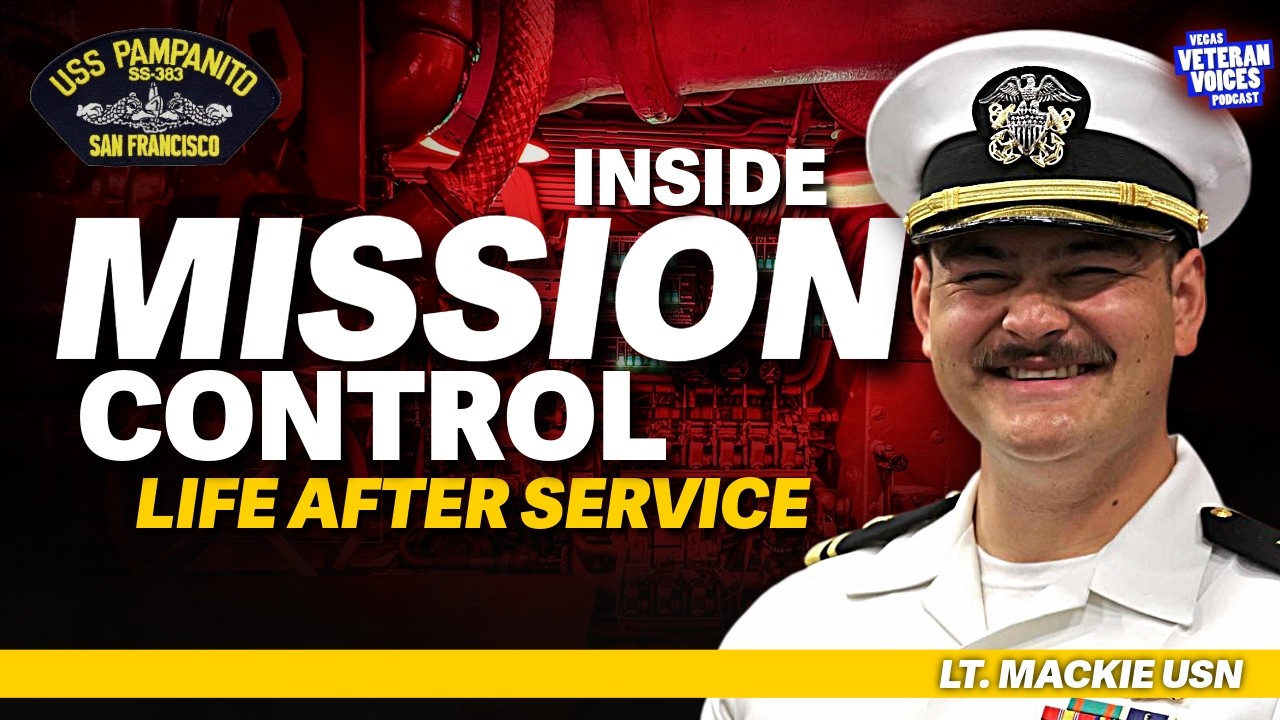
Emilio Mackie, a U.S. Navy Veteran and surface warfare officer, left the service in July and did what he says most Veterans skip. He took a break. He did not jump into a job or a relationship. He says he chose to be by himself and to sort through the experience.
“I chose to spend a lot of time by myself sorting through the experiences I had in service, going to therapy, and kind of rebuilding and redefining who I am today.”
He wanted someone with a specific kind of training, and he says how he found them.
“I actually went through Military OneSource to find a therapist who was specifically trained in transitioning service members.”
His case for why is short.
“Sometimes you need somebody who has the professional experience and also the reality check that you need to be successful in a transition.”
Mackie says he would recommend that path to anyone leaving. That is his view and we are reporting it. Military OneSource is a Department of Defense service, and its own site has its own rules about who qualifies and when.
The one the family noticed
Randall Parkes, a Marine Corps Veteran, drill instructor and founding MARSOC Raider, did not go looking. His wife did the noticing.
“My wife noticed that I was having issues.”
He tried the Naval Hospital, he says, and it did not work out, and COVID limited things. Later he got EMDR through the VA after he got out. For the match question his answer is a speed one: he says he put in a request and was talking to someone within about 48 hours. Parkes also says the VA has a bad reputation that it earned, and that his experience on the mental health side was phenomenal. The same system, he says, was a different story for his shoulder.
The one who gave up on the office
Tommy Nutzmann, a retired U.S. Navy Chief and creator of After the Uniform, started with the VA, and then the format changed under him.
“I had appointments that became like in person to now virtual. I need somebody to talk to in person.”
He did not stop looking. He found peers.
“Talking to people who are literally going through the same thing I was going through.”
He says he still has good days and dark days, and that his wife was with him on the worst ones.
Delvin Bourn, a U.S. Army Veteran, 82nd Airborne paratrooper and Gulf War Veteran, works with a nonprofit that runs peer-to-peer sessions at a gym, and says it is a different animal.
“It’s different than talking with your therapist.”
Nate Rosas, a U.S. Army Veteran of Afghanistan, said it in one of our earliest episodes, filmed before Vegas Veteran Voices was a nonprofit. He describes his Veteran hockey group as a place where service comes up freely.
“It gives us outlets to talk about the things that bother us that, you know, we may not be able to talk about with strangers or even with a psychologist or a spouse.”
The one who took a different route
Rachel Veronica, a U.S. Army Veteran and clinical hypnotherapist, tried talk therapy and found it did one job.
“Therapy can give you the awareness, but doing self-hypnosis on myself to really figure out my problems, that dug a little deeper.”
She is a hypnotherapist by trade now, and we report her view as hers.
The one who found it in a program
AJ Kehl, a U.S. Air Force Veteran and career firefighter, found his through a nonprofit treatment program. He had never seen a therapist in 20-plus years of service.
“It really was a safe environment. Like once we closed the doors, just me and her, we quickly built that rapport, that trust.”
Travis Jewell, a Marine Corps Veteran and 1/6 mortarman who now makes military comedy skits, says the match was the point.
“Just being able to talk to someone that understood where I was coming from.”
What “understands” means
Valdez also says what is missing. Explaining a deployment is hard, he says, when the person across the room has no experience of it.
“I get that we both wore the uniform. But it’s different.”
So there is a disagreement. Mackie and Kehl say a trained professional made the difference. Valdez says some of the VA therapists were not enough. Veronica says talk therapy got her aware and no further. Nutzmann, Bourn and Rosas say the match, for them, was a peer.
Nobody tells you which of these is right. They tell you which one worked for them.
We have never asked a guest, on camera, “How many people did you try before one clicked?” We are going to.
What VA says it offers
For the record, VA describes its mental health services as ranging from peer support to counseling, therapy and medication, and says you can call or walk in to any VA medical center. Vet Centers, VA says, are community-based counseling centers with services at no cost, all strictly confidential, and a free around-the-clock call center at 1-877-927-8387.
Where to go from here
These are places that exist and what each one is., and nothing here is medical advice.
- Las Vegas Vet Center A VA counseling center, separate from the hospital, with free confidential individual, group, couples and family counseling, including for PTSD, grief and military sexual trauma. 702-791-9170.
- Vet Center Call Center VA's Vet Center program describes itself as community-based counseling centers; services are at no cost and confidential. The call center, 1-877-927-8387, is a free around-the-clock line.
- Military OneSource A Department of Defense service with a 24-hour phone line and chat offering counseling, coaching and practical help with military life. 800-342-9647. Check its eligibility page for who qualifies after separation.
- VA: mental health VA's official page on its mental health services, from peer support to counseling and therapy, and how to start.
A listing is not an endorsement.
Related questions
If you are a Veteran in crisis or having thoughts of suicide, call 988 and press 1, or text 838255. The Veterans Crisis Line is free and confidential, 24 hours a day.
Go hear them say it
Every quote above links to the second it was said. Start with Mackie at 3:04. More places to turn in Southern Nevada are at Veteran resources in Las Vegas.
Stories quoted in this article
- Aboard a Submarine: What No One Tells You About Life After Service
- Wounded Warrior Project: From Afghanistan to Finding Purpose with Juan Valdez
- Every Marine Asks Where You Deployed. He Hated the Answer. / JMach & Tommy Nutz
- Every Marine Defends Their Boot Camp. He's One of the Few Who Saw Both. / Randall Parkes USMC
- Hypnotherapy ASMR w/ Rachel Veronica | Army Veteran, Addiction Recovery, Identity Rewire
- Something Wasn’t Right | Delvin Bourn (US Army Veteran)
- Redefining Veteran Healing w/ Shields and Stripes | AJ KEHL
- Every Lance Corporal Is Thinking It. Travis Jewell Says It. (@jewell_jits)
- How Hockey Is Giving Veterans a Second Chapter / Really OK Hockey / Las Vegas Warriors @ Able Baker (recorded before Vegas Veteran Voices became a nonprofit)