
What jobs can Veterans get without a degree?
Nobody asked for a diploma. They asked for five years of night school, a license, a clearance, or the nerve to knock on a door. Eight Veterans on what 'no degree' really costs.
By Vegas Veteran Voices,
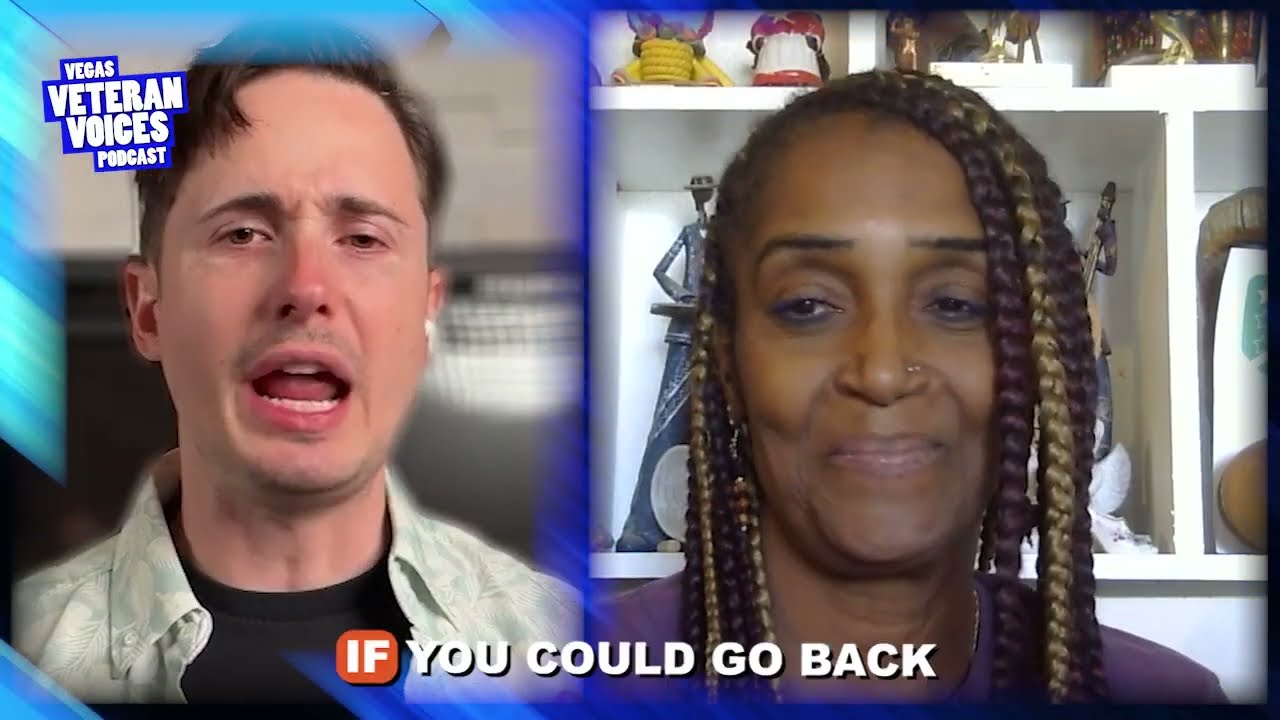
From Breaking Barriers: Evelyn Pacheco (ARMY VET) on Becoming Nevada’s First Black Female Union Plumber
Evelyn Pacheco carries business cards, and she hands them to people who are working. Burger King, McDonald’s, Walmart, wherever she happens to be. Then she asks the question that starts the conversation.
“Why are you here doing this when you could be making good money, you know, you could be making up to 100,000 a year and you’re doing this? Why?”
Pacheco is a U.S. Army Veteran and Nevada’s first Black female union plumber. She gets to say that because she lived it. She also knows what the cards leave out, which is the same thing every “jobs without a degree” list leaves out. The jobs do not ask for a degree. They ask for something else, and the something else has a price.
This is the companion to what jobs Veterans actually get, which is about the odd paths. This one is narrower. Eight Veterans, in interviews filmed by Vegas Veteran Voices, a Las Vegas nonprofit, on getting work without a diploma, and on what the work asked for in its place.
A degree is not the only thing that costs money
Start with the trade Pacheco is talking about. The Bureau of Labor Statistics lists the typical entry requirement for plumbers, pipefitters and steamfitters as a high school diploma or equivalent. It also says most learn the trade through a four or five year apprenticeship, with about 2,000 hours of paid on-the-job training a year. The median pay was $63,800 in May 2025.
Read that last number twice. Pacheco’s “up to 100,000” is the top of the range, and the median is nationwide, not Las Vegas. Neither number is a promise. But notice what is on the list: years. Pacheco spent hers going to class at night around a full work week, as a single parent. The first check at journeyman pay is the part she remembers.
“This says $1,500 on this check. I have never in my life received one week of pay for $1,500.”
She says it changed everything, and made her more independent. She is just as plain about what got her there.
“You have to go to school either at night or during the day and you have to get good grades, too. You have to show up on time.”
So the first answer to “what can I get without a degree” is a trade. The second answer is that the trade is a degree with a different building. Five years, grades, attendance.
The shorter version
There is a faster door, and a Las Vegas instructor walked through it. Randy Nichols is a U.S. Navy Veteran and electronics technician who now teaches plumbing at a Las Vegas trade school. He worked at a hospital for seven years after he got out. They did not have a plumber, so he became it. Then his bosses told him to get certified.
Nichols is not selling anybody a dream. He is selling a job nobody wants.
“With plumbing people always, you know, they’ll say it’s the dirty job. It’s the job nobody wants. I look it as an opportunity to make money nobody wants to make.”
What he had before the class was the Navy. Ureal Irving, a U.S. Army Veteran who founded Envision Footwear, was a heavy wheel construction mechanic. He says the recruiter described the job as something cooler than it was, and that it turned out to be trucks. He stuck with it anyway.
“I learned it. I learned it well. I became the go-to guy.”
No diploma came up. The repair work did the talking.
Or just start working
Some of these stories do not have a school in them at all. Lucky Lopez, an Army National Guard Veteran and car business YouTuber, was born in Las Vegas. The Army turned him down at first over a knee surgery. So he did what the city let him do.
“I started working here in Vegas. I opened up a shop back in 2000 just working on cars and just kind of fell into the automotive industry working on stuff.”
He later opened a car dealership, which is a longer story, and his.
Caitlin Duffy, a U.S. Army Veteran and 50 cal gunner, got out and called the one civilian professional she knew, her own mortgage lender. She asked whether she should go back to college. He offered her a full-time job answering phones.
“I started with him like three days later. Got licensed right away and I ended up working for that company for almost 10 years.”
Look at the word “licensed.” Not a degree, a license. A license is a small exam with a big gate, and it keeps coming up in these stories as the thing that stands in for a diploma.
Two Marines who say college was not it
Here the guests have an opinion, and it is the same one.
Bruce Cardenas, a Marine Corps Veteran who went on to the LAPD, says the Marine Corps built his foundation. He tells people who have no calling to start with the military.
“If you have no calling, you’re not sure what you want to do. Maybe college isn’t your answer. And I don’t think it is for a lot of people.”
Travis Jewell, a Marine Corps Veteran and 1/6 mortarman, tried it in person and disagreed with the room.
“That’s why college wasn’t for me when I got out.”
He says he looked around a classroom of 18 and 19 year olds and could not take it. He did something else, and what he did was a software program for Veterans, which is its own kind of schooling. A degree is not the only way to get taught. It is just the one with the best marketing.
The catch
Here is where it gets less comfortable. A lot of good jobs do want the paper. Edward Haines, a retired Marine Master Sergeant who spent 20 years in signals intelligence, went back to school, finished a degree in exercise science, and took a board certification test to become an athletic trainer. The route into athletic training he describes ran through a degree program.
He did learn something in the Marine Corps about degrees, though, from the other side. He was explaining to a young Marine why everyone, including the linguists, got the same unglamorous work.
“I had other linguists out there of the same caliber. Just because they didn’t have a degree doesn’t mean they were like less than you.”
That is the quiet truth under the whole question. In uniform, nobody checked. Out here, somebody will. The jobs in this piece are the ones that check something other than a diploma.
What they all had
Line the eight up. Pacheco had five years of apprenticeship. Nichols had a certificate and seven years at a hospital. Irving had a mechanic’s job he learned well. Lopez had a shop he built himself. Duffy had a license. Cardenas and Jewell each had the Marine Corps behind them, and an opinion about classrooms.
Every one of them had a thing they could do, or had started to learn. Cardenas says the Marine Corps built his foundation. Then he spent a year selling Mitsubishis while the LAPD finished checking him out.
None of this means the paper is worthless. Haines needed it. It means the question to ask is not “do I need a degree.” It is “what does this job check, and can I get that without four years in a classroom?”
Where to go from here
No advice from us. These are places that exist, what each one does and how to reach it.
- Veterans Career Employment Team (Nevada DETR) A state employment program. Career coaches help Veterans and eligible spouses with career planning, resumes, interview preparation and job search, in person at EmployNV Career Hubs or online.
- Nevada Women in Trades A Las Vegas nonprofit that prepares women for apprenticeships and careers in the building trades. Not only for Veterans. Founded by Evelyn Pacheco, quoted above. (702) 801-6591.
- Department of Labor, Veterans' Employment and Training Service: find a job The federal starting page for Veterans looking for work. It points to nearly 2,400 American Job Centers, apprenticeships through Apprenticeship.gov, and federal hiring guidance.
- VA: GI Bill for on-the-job training and apprenticeships VA's own page on using GI Bill benefits while you learn a trade on the job or in an apprenticeship. The rules are on the page.
A listing is not an endorsement.
Related questions
If you are a Veteran in crisis or having thoughts of suicide, call 988 and press 1, or text 838255. The Veterans Crisis Line is free and confidential, 24 hours a day.
Go hear them say it
Every quote above links to the second it was said. Start with Pacheco. Our full list of employment and education help in Southern Nevada is at Veteran resources in Las Vegas.
Stories quoted in this article
- Breaking Barriers: Evelyn Pacheco (ARMY VET) on Becoming Nevada’s First Black Female Union Plumber
- From Navy to the Trades: How NTI Builds Careers For Veterans
- Get Out Of Your Own Way | Bruce Cardenas, USMC + LAPD
- Every Lance Corporal Is Thinking It. Travis Jewell Says It. (@jewell_jits)
- He Listened for 20 Years. Now He Tapes Ankles at a High School.
- He Joined the National Guard to Work on Vehicles | Lucky Lopez
- From 50 Cal Gunner to VA Loan Nerd | Caitlin Duffy’s Veteran Story
- From Iraq to Iconic: The Wild Story Behind Envision Footwear (recorded before Vegas Veteran Voices became a nonprofit)