
What is it like being in the Navy?
A destroyer officer woke up with his hand in three inches of sewage. A retail specialist stared at the ocean and wrote a song. Seven Navy voices on what the recruiter calls boats.
By Vegas Veteran Voices,
From Aboard a Submarine: What No One Tells You About Life After Service
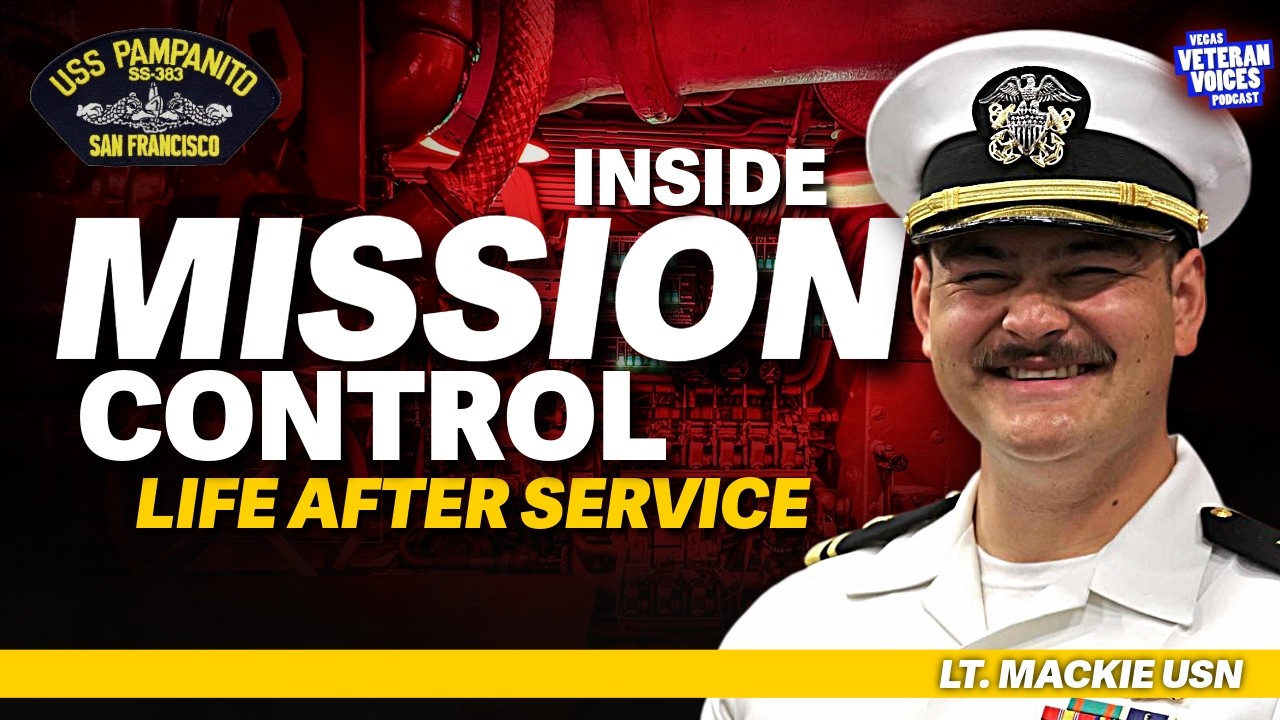
A surface warfare officer wakes at three in the morning on a destroyer in the South Pacific. The ship rocks him gently. He reaches an arm out of his rack to find the floor.
That is Emilio Mackie, a U.S. Navy Veteran who spent his tour in Japan and San Diego, and the floor is not where he left it.
“I reach my hand out of my rack. I touch the floor and it submerges in what?”
Seven Navy voices told us what it was like, in interviews filmed by Vegas Veteran Voices, a Las Vegas nonprofit. This one is thinner than we would like on the deck-by-deck details of ship life, and we say so at the end. What we have is a surprisingly consistent picture: the Navy you imagine and the Navy you work in are different ships.
The recruiter
Jennifer Marshall, a U.S. Navy Veteran, actress, firefighter and EMT, came from a family that was all military. The only question was which of them would join.
“I didn’t know anything about the Navy. I was like, ‘Okay, sounds good. Boats.’”
Mackie came for a different poster.
“I grew up watching Top Gun as a kid and it was super cool seeing the fighter jets and ships.”
Boot camp, Navy style
The Navy says boot camp is nine weeks at Recruit Training Command in Great Lakes, Illinois, ending with a test called Battle Stations. Marshall noticed something else about her fellow recruits.
“There were a lot of people in boot camp. They didn’t know how to swim.”
Many were from the Midwest, she says. On a ship, that could matter.
Dr. Cornelius Jones, a U.S. Navy recruit division commander, recruiter and author, was on the other side of it at Great Lakes. He says the Navy’s version of a punishment was a physics lesson.
“We would make the walls sweat, the condensation, by making them exercise.”
He pushed the racks against the bulkhead to clear a floor. He is careful about one thing.
“There was always a purpose. So we weren’t just bullying people.”
The job
2K Kenny is an active duty Navy Retail Specialist Second Class and a musician, so he is not a Veteran yet. He will tell you his job is the best one in the Navy.
“I end up becoming the best rate in the Navy, which is a retail specialist.”
The job is a lot of jobs.
“I’m a jack of all trades. I was a barber. I did laundry. I was in the ship store.”
The best part, he says, is the time at sea. He would go out on deck during sweepers and stare at the water.
“I would just look at the water and I would just get lost.”
One of those afternoons turned into a song. He has also been somewhere he had never heard of.
“I never even heard of Bahrain until I got to Bahrain.”
The part with Marines
Joe “Doc” Worley, a U.S. Navy corpsman with a Bronze Star with valor and a Purple Heart, says his Navy was mostly spent with someone else’s branch.
“I went into the Navy and ended up as a corpsman with Marines.”
“I love my Marines. And I was with a good unit of guys. I was with 21 Marines.”
He describes his career in three words.
“My military career ended up being, you know, school, war, hospital.”
The flight
Jennifer Bennie, a U.S. Navy Veteran, naval aviator and historian, was winged three days after 9/11. After her first deployment, a nine-month one in the Middle East, she drove home across a bridge in San Diego.
“I remember after my first deployment driving home to my apartment in San Diego across the Coronado Bridge and thinking, I am an American woman in my own car driving to my own apartment and I’m a Navy pilot and this would never happen in the Middle East.”
After the Navy
Tommy Nutzmann, a retired U.S. Navy Chief and creator of After the Uniform, did the whole thing.
“I joined the Navy at 17 years old. I left at 37 and I didn’t know who I was.”
Mackie, who finally got out, has a harder time explaining it to people who were never on a ship.
“It’s hard to relate to some people when you’ve been on like a midnight watch in the South China Sea.”
And the sewage
Mackie’s job was repair officer, which meant the damage control assistant’s leftovers, including the toilets. At 3 a.m., the alarm went off, and the flooding was not the water kind.
“There is 3 inches of poop water rising amongst the racks, flowing out of the toilets.”
For two days he and his crew did nothing but repair sewage systems. His review of the Navy’s recruiting pitch:
“They did not tell me about that when I was being recruited for the Navy.”
What we do not have
Seven voices, and only two of them, Mackie and Kenny, say much about what an ordinary day on a ship is like. We do not have anyone from a carrier, a submarine crew, the Seabees or Naval aviation maintenance, and nobody from the 1970s or 1980s. The Navy has more than 100 career paths, per navy.com.
Where to go from here
No advice from us, and nobody here is recruiting.
- Navy careers (navy.com) The Navy's own career pages. The headline says over 150 roles; an FAQ on the same page says over 100 career paths.
- VFW Department of Nevada The state headquarters of the Veterans of Foreign Wars and a starting point for finding a local post. 702-538-0873.
- Nevada Department of Veterans Services (Las Vegas office) The state agency for Veterans. It connects Nevada Veterans and families to education, housing, employment and health care benefits. (702) 486-3830.
A listing is not an endorsement.
Related questions
If you are a Veteran in crisis or having thoughts of suicide, call 988 and press 1, or text 838255. The Veterans Crisis Line is free and confidential, 24 hours a day.
Go hear them say it
Every quote above links to the second it was said. Start with Mackie. More from sailors is at our Navy page, and Marines get their own say in What is Marine Corps boot camp really like?. If you are in Southern Nevada, our list of posts, clubs and services is at Veteran resources in Las Vegas.
Stories quoted in this article
- Aboard a Submarine: What No One Tells You About Life After Service
- Behind the Beat - 2K Kenny Made Love Songs Underway
- You’ve Seen Her on Stranger Things. Here’s What Nobody Knew About This Navy Veteran.
- Every Veteran Is On Their Own After the Uniform. Doc and the MIC Founder Prove That's a Lie.
- Every Veteran Blames Their Recruiter. He Was the Drill Instructor Who Became One. / Dr. Jones USN
- The Woman Navy Pilot Who Became Addicted to History | Jennifer Bennie | A Walk With History
- Every Marine Asks Where You Deployed. He Hated the Answer. / JMach & Tommy Nutz