
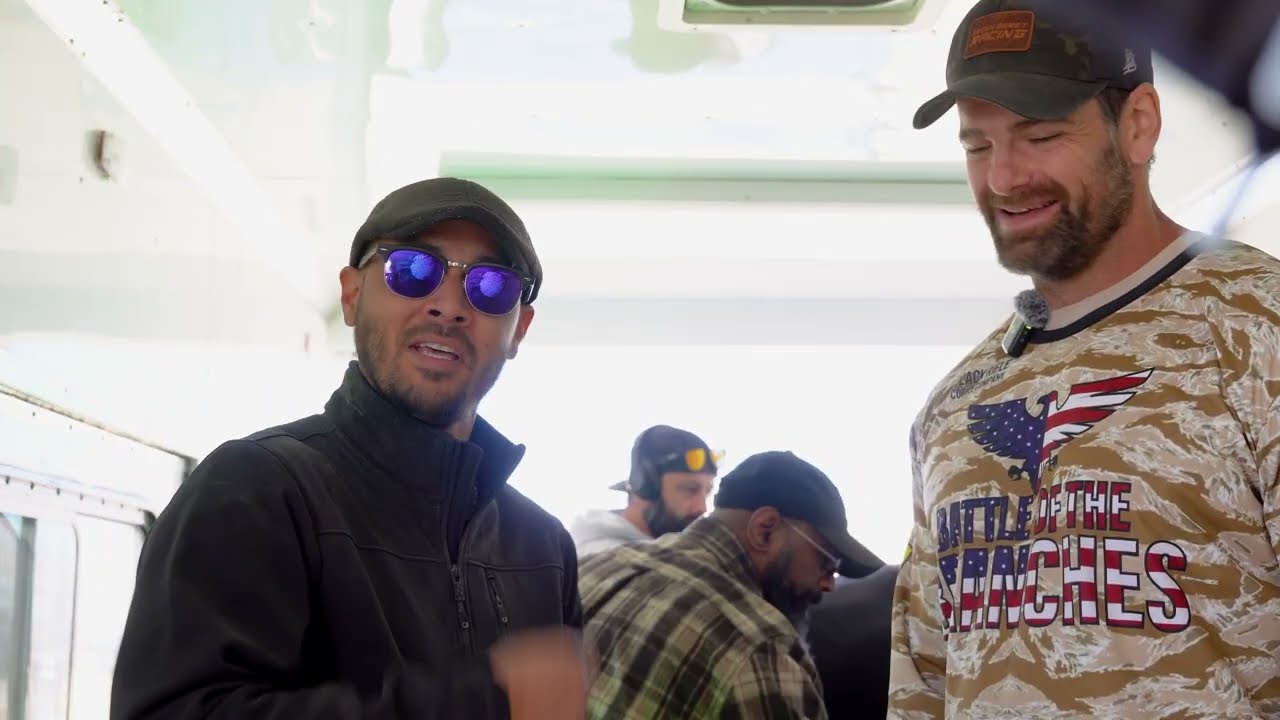
What do Veterans do all day after the military?
Nobody fills in your calendar anymore. Fourteen Veterans on what they do with the day, including the ones who cannot hold a regular job.
By Vegas Veteran Voices,
It is 0900 on a Tuesday. For years that hour belonged to somebody else, along with 0500, chow and most of your afternoons. Now it is yours. So is 1000. So is the rest of the week, and nobody on earth is waiting on you.
In the military even the nothing was scheduled. Hurry up and wait was at least somebody’s plan. Then you get out, or you get hurt, or you retire, or the job lets go of you, and every hour of the day is yours. All of them. Nobody briefed that part.
People ask it as a joke: so what do you do all day? Veterans ask each other the same question and they are not joking.
In interviews filmed by Vegas Veteran Voices, a Las Vegas nonprofit, fourteen Veterans told us what they did with those hours. Several cannot hold a regular job and say so plainly. Not one of them answered “nothing.” And almost nobody started with a mission. They started with something smaller: one thing, at a set time, that they did not want to miss. One of them does hers on Thursday mornings. We are going to call it a Thursday.
First comes the quiet
Emilio Mackie, a U.S. Navy Veteran and surface warfare officer, went from 24-hour duty days and watches in the middle of the night to a calendar with nothing on it. What he struggled with most, he says, was the free time.
It is scary at first, he says, when your hands go still. He also thinks the stillness is the opening.
“That’s like the perfect opportunity to start crafting who you want to be in the future.”
Juan Valdez, a Marine Corps Veteran and Purple Heart recipient who now works with Wounded Warrior Project, was medically retired after ten years. He moved home to Boston and enrolled in school. On paper that is a full day.
“I was just lost. I was like a zombie.”
On autopilot, he says. Going through it without feeling any of it. A schedule and a reason to keep one turn out to be different things.
“You’re done with your career”
Delvin Bourn, a U.S. Army Veteran who jumped with the 82nd Airborne and served in the Gulf War, drove an 18-wheeler after the Army and figured he would do it for life. Around 2014 his arms and legs went numb. He says a doctor looked at him and told him he was done. Done with the appointment, Bourn asked? No. Done working.
He lists what he has been handed since, and it is a long list. Then:
“I’ve got all this stuff that should make me just want to sit on the couch and suck my thumb. But now I’m like, let me go do something.”
Jason Brooks, a medically retired Marine who was a Recon and SERE instructor, got that news in 2005. He is not selling a comeback story. He says some days he cannot get out of bed properly, and he is exact about why a normal job is off the table.
“I can’t work a regular job because I can’t be committed to showing up somewhere, because if I’m having a bad pain day, guess what? I’m done.”
So he built a working life out of the days he can show up. He teaches firearms. He does executive protection work with the UFC, which for a man who has done martial arts since he was a kid is not a consolation prize.
“There’s always something you’re going to be dealing with, but you have to know that that’s not the end for you.”
A chair, a dance floor, a classroom
Letoi Adams, a U.S. Army Veteran and adaptive athlete with Paralyzed Veterans of America, says it took her four or five years to get through her depression and learn to live in a wheelchair. Then, at the VA in Long Beach in 2015, she strapped into a different kind of chair and went looking for another one to hit.
“I sat in a basketball chair, and I was like, this is what I want to do.”
“That was the most fun I had in many, many years.”
She says she tries to stay busy all year now, and the National Veterans Wheelchair Games are on her calendar every year. The Games are one of six national events run by VA’s adaptive sports and arts office, which lists the next Games for July 14 to 19, 2027, in Orlando.
Valdez, the zombie in Boston, found his in a ballroom. While he was coming to terms with being medically retired, he took up dancing.
“Dancing is something that I can do fairly well. I’m not gonna say I’m really good. I’m pretty good.”
Pretty good was enough. He says he can get by as a ballroom instructor, and that the bigger thing it gave him was people.
Alfred Brenner, a Purple Heart recipient, retired Marine K9 handler and author, gave the most honest status report we have on tape:
“I need something to do. I don’t have a job. I’m going back to school.”
He joined the Marines for school, he says, and it has taken him 16 years to get near a bachelor’s degree. He wrote a book along the way and wants to speak for a living.
Jason Lee Morrison, a Marine Corps Veteran, Recon Marine, writer and poet, lost his security clearance and with it his job, in the middle of a divorce.
“I’m sitting around feeling sorry for myself, thinking, I’m not even at square one. I can’t get to square two. I’m at square zero here.”
Then, he says, it occurred to him that zero is a place you are allowed to start from. He wrote a book too. If writing, painting or music is your version, VA runs a national competition for it: the National Veterans Creative Arts Festival, co-presented with the American Legion Auxiliary since 2000, with divisions for art, creative writing, dance, drama and music.
Thursday mornings
Bobi Pike-Oates, a retired Air Force Senior Master Sergeant, retired in 1999 and has apparently not sat down since. She rattles off her commitments the way some people list their medications. One of them has a day of the week attached.
“One of my other projects I do is I do funeral services for unaccompanied Veterans on Thursday mornings.”
That is at the Veterans cemetery in Boulder City, for Veterans who have nobody else coming.
Bourn went the same direction once he could not work. He was sitting at home, he says, and it was not going well.
“I’m like, God, I got to do something.”
So he joined nonprofits, worked with churches, commanded a Veterans post and started an organization of his own. His view is that a mind with nothing to do goes looking for trouble.
It is less glamorous than it looks online. Robert “Gunny Claus” Porter, a Marine Corps Veteran of 21 years, turns up at events around the country, and people tell him how busy he is.
“90% of my time is sitting at home on my computer trying to figure out how to get to this location or that location. What can I do? How can I help?”
There is room. VA says 27,825 volunteers gave it more than 3.6 million hours in fiscal year 2025, according to its volunteer office. And Dean Goble Jr., a retired Army Green Beret and Black Rifle Coffee philanthropy director, has no patience for “there’s nothing out there for me.”
“Whether you’re into hunting or fishing or whatever your jam is, there is probably a nonprofit out there that supports that.”
Give them your cell number, he says, and they may harass you. He means it kindly.
Does it have to be a mission?
Here they split.
Ross D. Bryant, a U.S. Army Veteran who leads UNLV Military and Veteran Services, says yes. He is still working and has no plans to stop.
“We’re all mission focused. We were raised in the service to be mission focused. What’s the mission today?”
Nick Merrick, a former U.S. Army Green Beret and founder of Green Beret Racing, says the mission does not have to be the job. The job goes away someday, he points out. His organization pays for Veterans to go do a hard thing of their own choosing, and he does not much care which thing.
“The organization was titled and built for, let me give you purpose beyond profession.”
Michael D’Angelo, a Marine Corps Veteran, machine gunner and stand-up comic, is living proof you can turn the thing you love into the mission. He would like a word with you before you try.
“If you want to get into comedy, man, don’t try and do it for work. Be a hobbyist.”
Money changes it, he says. It stops being fun.
Mackie, whose hands went still, warns against the opposite mistake: cramming the calendar so you never have to hear the quiet.
“If you are trying to pass the time with adding more stress into your life, you’re going to burn out and it’s going to hurt more.”
And some people are simply fine. Pike-Oates, of the Thursday mornings, is married to a man who did it the other way.
“When he retired, he retired.”
Photography, computers, his 3D projects. She reports that he is happy and content, and that she brings him to the Air Force ball as proof of life.
Randall Parkes, a Marine Corps Veteran, drill instructor and founding MARSOC Raider, keeps the body and the purpose on separate lists. The body list is short.
“I go to the gym like three times a week. I try and surf three times a week. I run.”
The other list has one item. You have to decide, he says, that:
“My next chapter after the military is going to be just as badass and fun as the last chapter.”
So what do you do all day?
Go back through what they named. A basketball chair. A dance floor. A classroom at 40. A firearms range on the good days. A cemetery on Thursday mornings. A laptop and a map. A surfboard.
Not one of those is a career, and most would not survive a performance review. Every one has a time and a place, and at most of them somebody is expecting you. Bryant calls that a mission. D’Angelo would call it a hobby and tell you to keep it that way. Merrick’s phrase is purpose beyond profession. Pike-Oates just calls it Thursday.
Whatever you call it, none of them waited to feel ready. They put one thing on the calendar and showed up for it.
Where to go from here
No advice from us. These are places that exist, what each one does and how to reach it.
- VA Adaptive Sports and Arts The VA office behind six national events, among them the National Veterans Wheelchair Games, the Golden Age Games and the National Veterans Creative Arts Festival. The page lists dates, registration windows and a contact for each.
- Paralyzed Veterans of America, Nevada Chapter The Nevada chapter of Paralyzed Veterans of America. Advocacy, benefits support and adaptive sports for Veterans with spinal cord injury, MS or ALS. (702) 646-0040.
- Team RWB Nevada, Las Vegas chapter The Las Vegas chapter of Team Red, White & Blue, a national nonprofit that connects Veterans through fitness and social events. The chapter finder covers the rest of the country.
- VA Center for Development and Civic Engagement (volunteering) How VA takes volunteers. You fill out a form and a local representative contacts you. The programs it lists include the Volunteer Transportation Network, which drives Veterans to appointments.
- Wounded Warrior Project A national nonprofit with programs for wounded Veterans and service members, including mental wellness, peer support and adaptive sports. Juan Valdez, quoted above, works for it.
A listing is not an endorsement.
If you are a Veteran in crisis or having thoughts of suicide, call 988 and press 1, or text 838255. The Veterans Crisis Line is free and confidential, 24 hours a day.
Go hear them say it
Every quote above links to the second it was said. Start with whoever sounded most like your Tuesday. And if you are in Southern Nevada and looking for a Thursday of your own, the teams, posts and programs we know about are at Veteran resources in Las Vegas. Pick a day.
Stories quoted in this article
- This Shouldn’t Have Worked… But It Did
- Aboard a Submarine: What No One Tells You About Life After Service
- Wounded Warrior Project: From Afghanistan to Finding Purpose with Juan Valdez
- Something Wasn’t Right | Delvin Bourn (US Army Veteran)
- Why SERE Breaks People | Marine Recon Instructor Explains Survival Training
- Adaptive Sports Saved My Life | Letoi Adams’ Journey
- Purple Heart Marine Survived IED. Losing His Combat Dog Was Worse. | Alfred Brenner USMC
- This Marine Lost Everything… And Had To Start From Zero | Jason Lee Morrison
- She Paved The Way For Women In The Air Force | Bobi Pike-Oates | US Military
- The REAL Story of GUNNY CLAUS (You’re Not Ready)
- How Black Rifle Coffee Company Serves Veterans After the Uniform Comes Off w/ Dean Goble
- Most Veterans Don’t Know Their Education Benefits, The Man Who’s Helped 9,000 Claim Them
- Why Do Marines Treat Dark Humor Like Therapy? Michael D’Angelo USMC 0331
- Every Marine Defends Their Boot Camp. He's One of the Few Who Saw Both. / Randall Parkes USMC