
Do military marriages last?
Everybody has heard that military couples fall apart. Thirteen Veterans on the marriages that ended, the ones that held, and what the job did to both.
By Vegas Veteran Voices,
From Most Military Couples Fall Apart. Here's Why They Didn't.
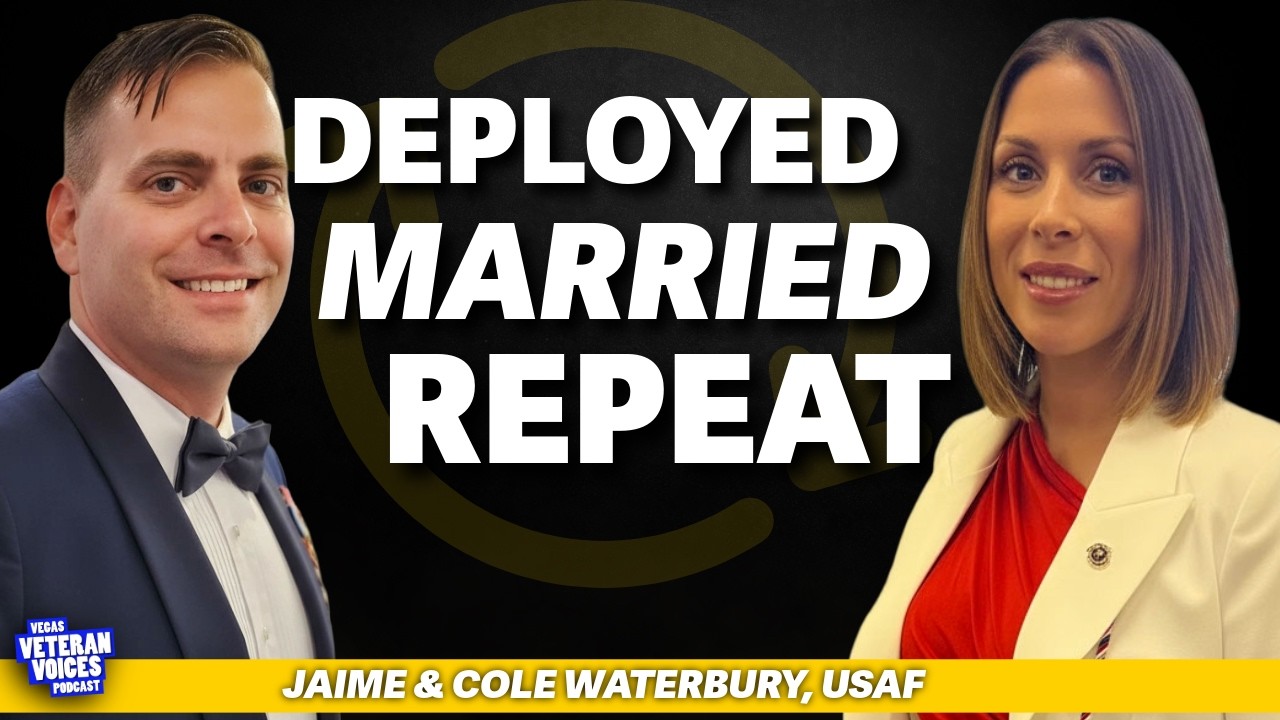
Jamie Waterberry was eating lunch in a chow hall in Iraq when a large man walked in front of her table. It was her husband. He was deployed too, to another part of the country, and he had come up the road to see her.
She threw her tray in the trash. Later she asked how he had gotten there. A little road, he said, by her telling. Nothing to worry about. The road had a name, and the name was IED Alley. (He says he did not put it quite like that.)
That is a military marriage in one lunch. The person you married, in a place neither of you chose, and one fact left out for your own good. She did not ask how bad that road really was until a few years ago.
We named their episode after the thing everybody says: most military couples fall apart. In interviews filmed by Vegas Veteran Voices, a Las Vegas nonprofit, thirteen Veterans told us about their own marriages. Some ended. Some held. Almost nobody blames the same thing.
What the numbers will and will not tell you
Start with how many marriages there are to lose. The Department of Defense’s 2024 demographics profile says 47.6 percent of active duty members are married. In the services that reported it, a little over 5 percent are married to someone else in uniform.
Whether the job breaks those marriages is harder to pin down than the barracks version suggests. One peer-reviewed study, published in the Journal of Population Economics in 2014 and built on military records from 1999 to 2008, found that every extra month deployed raised the risk of divorce. It found the effect was stronger for couples who married before 9/11, the ones who had not signed up for that many deployments.
So the folklore is not nothing. It is also not a sentence passed on your marriage. A statistic can tell you the road has a name. It cannot tell you who walks in the chow hall.
The service wants you married
Daniel Coffeen, a U.S. Army Veteran, Ranger School graduate and Medical Service Corps officer, says the quiet part first.
“The military, especially the Army, encourages you to get married.”
It comes with more money, he says, and orders that keep the two of you together. He is not bitter about her.
“I liked my ex-wife a lot. We had a good partnership.”
Then his name came up for Special Forces selection while she was in a training program of her own in Texas. He went to Texas. He calls the choice one of the great regrets of his life, and the marriage ended anyway.
The incentive works on enlisted pay too. Nate Rosas, a U.S. Army Veteran who went to Afghanistan, did the paperwork first and the romance second.
“We just went to the courthouse and got married so we could immediately move out, and then we had our engagement period when we were technically married.”
He did not wear a ring. It worked. He credits his wife with making the move to civilian life a great deal easier.
The same institution that pays you to marry also expected you to show up to the ball with a date, and for a long time it had rules about who the date could be. Greg Cope White, a Marine Corps Veteran and author of The Pink Marine, served as a gay man when that was against the rules. He always had a woman on his arm for the events.
“I came close to getting married twice.”
He did not, and it is the reason he gave for not reenlisting after six years. Every Monday the platoon traded weekend stories, and every Monday he changed the he’s to she’s.
“At that point I respected my fellow Marines too much to continue changing those pronouns.”
One man married partly because the Army made it the sensible move. Another left the Marine Corps because it had no room for the truth about who he would marry. Same pressure, pointed two ways.
Half of the first five years
Jamie Waterberry, an Air Force Veteran who works in corporate philanthropy, met her husband Cole Waterberry, also a Veteran, the way a lot of couples in uniform do. They were next-door neighbors in the dorms. Then the schedule took over. Cole did the math:
“In our first five years of marriage, we were away from each other for about half of it.”
Her deployments, his deployments, her temporary duty, his. In the military, he says, nothing ever matches up. Which means the ordinary grind of a first year, the part where you find out what the other person is like to live with, showed up late.
“You learn in year one of marriage everybody’s little quirks and stuff like that. We learned about them in like year five to six.”
Cole’s advice for anyone coming back from a week away or a year away is the most useful sentence in the episode, and it is about furniture. Life went on while you were gone. Things moved. There was a reason.
“You act as a guest. And that sounds weird to say that you’re a guest in your own home.”
Jamie’s advice runs the other way, at the one in uniform. If your partner did not grow up in this and never served, you have taken them out of everything they know and dropped them in a town they cannot find on a map.
“Their partner doesn’t know what they don’t know.”
What gets left out
Back to that road. Cole was running it regularly, and Jamie only learned years later how often it got hit.
“He really downplayed how dangerous this was.”
He did the same on the phone. She remembers a call where something exploded on his end.
“I’m like, what is that? He’s like, ‘Oh, don’t worry. I’m in the bunker. It’s cool. We’re good.’”
They laugh about it now. They can, because she wore the same uniform and knew what a bunker was. Most spouses get the edited version and no way to check it.
Nobody edits it for the spouse at home, either. Bobi Pike-Oates, a retired Air Force Senior Master Sergeant, was married to another airman, and noticed who the system forgot.
“When I deployed, nobody asked my husband how he was doing. And when he deployed, nobody really asked me how I was doing.”
She raised it with the family readiness people on base. They told her they look after dual-military couples now.
And sometimes the spouse is the one who sees it first. Lindsay Gutierrez, a U.S. Air Force Veteran and two-time living organ donor, says her personality shifted and she was the last to know.
“My husband was the one who noticed things first.”
She thought it was a husband being a husband, and took it personally for a while. Then she went looking, and found other people describing what she calls the symptoms of a traumatic brain injury. It was her husband who had sent her looking.
The ones that ended
Nikki Kraus, a U.S. Air Force Veteran and weather forecaster, spent the last years of her marriage holding up a front.
“I’m just still trying to put on this mask in the relationship and to the rest of the world that I wasn’t broken.”
She says she tried every avenue she could think of, couples counseling included. We only have her side of that marriage and we are not going to referee it. What she can speak to is the night she stopped.
“And finally, the pain outweighed the fear of leaving.”
“I had nothing. I left with $1,000 in the bank.”
A ten-foot U-Haul, her car on a trailer behind it, and a fresh start. She says that is what built her.
AJ Kehl, a U.S. Air Force Veteran with more than 22 years of service and a career firefighter, describes what a divorce in uniform does to the next relationship.
“I went through a couple divorces during my time in the military, which really made me feel a lot of shame and guilt, like maybe I was an inevitable failure at relationships.”
He assumed the next one would fail too. Years later he has a blunt explanation for the first two.
“I was putting the wrong things first.”
Billy Wiland, a Marine Corps Veteran, attorney and gym owner, tells his as a joke first. After law school he missed the Marine Corps and wanted back in.
“My wife at the time, she said she would divorce me if I went back to the Marine Corps. So I’m like, okay, I guess I’m not going back.”
Then a friend called about contracting work overseas, at a number that changes a household’s opinion.
“I let my wife at the time know and she said, ‘How soon can you leave?’”
That gets a laugh in the room. A few minutes later he says what he came home with ended the marriage, and what followed nearly ended him. It is his story to tell and he tells all of it.
Anisa Palmer, an Iraq combat Veteran of the 82nd Airborne and founder of I Will Survive, was married to another Veteran. She calls the divorce horrible, says she is “so grateful to co-parent with him” now, and still turns the question on herself.
“I just wish that maybe it was something in me that could have helped him better while we were married.”
That is a soldier with a combat deployment of her own, wondering if she should have carried more.
If any of this is you, Delvin Bourn, a U.S. Army Veteran and 82nd Airborne paratrooper, has seen what happens when a Veteran in the middle of a first divorce sits down in a room of other Veterans, at the peer sessions run by Merging Vets and Players.
“It’s kind of daunting, but then they look around, ‘Hey, how many you’ve went through a divorce?’ Everybody’s hand goes up and they’re like, ‘Oh, wow. I’m in the right place.’”
The ones that held
Joe “Doc” Worley, a U.S. Navy corpsman who holds a Bronze Star with valor and a Purple Heart, was wounded days before he met his newborn daughter. He lists what he had going for him, and he puts it in this order.
“One thing about me, I have an amazing support system. I’m still with my wife.”
He is not bragging. He is explaining why he ended up in nonprofit work.
“I don’t know how people do it without the support system that I had.”
Pike-Oates got her second marriage out of the same assignment that ended her first. She tells it in the time it takes to read a duty roster.
“So I went to Osan Korea. Got divorced. Met my husband over there. I was his quality assurance inspector.”
They are still married. Her explanation for why is not romantic and is probably correct.
“He might be going through a rough spot. I was doing okay, or we switch, but we’d be there to help each other out.”
Kehl is married again. At his retirement ceremony, he says, his family had the front row, and none of the ribbons mattered in that moment.
And the Waterberrys are sixteen years in, coming up on their ninth move, with one dispute left on the docket.
“He has a specific way shirts are to be folded. I have a specific way towels are to be folded, which we still haven’t passed that hurdle, but we’ll get there.”
So do they last?
Some do. Listen to the ones that did and nobody says love conquered all. Pike-Oates says they took turns. Worley says he had help. The Waterberrys say they learned each other five years late.
Listen to the ones that did not and you will not hear much about a villain. Kehl says he had his priorities upside down. Kraus says she wore a mask until she could not.
The service was a third party in every one of these marriages. It set the wedding date for some, the address for all, and the list of things one person could not say to the other. It did not decide how any of them came out. The people in them did that, mostly late, mostly by saying the thing they had been leaving out.
Jamie Waterberry finally asked about the road. Cole told her.
Where to go from here
No advice from us. These are places that exist, what each one does and how to reach it.
- Las Vegas Vet Center A VA counseling center that is separate from the hospital. Free and confidential, and its page lists couples and family counseling. For Veterans and service members who meet the Vet Center criteria, and their families. The national Vet Center line is 877-927-8387.
- Military OneSource: non-medical counseling A free, confidential, short-term Department of Defense counseling service that covers relationship and marriage problems. For service members and their families, and for 365 days after separation. 800-342-9647, any hour.
- Nellis AFB Military and Family Readiness Center The base information and referral center for active duty, Guard, Reserve, retirees and their families, with relocation help, financial readiness and classes. 702-652-3327.
- VA Caregiver Support Line A VA phone line for the spouse, family member or friend who is looking after a Veteran. Open weekdays. It connects callers to their local Caregiver Support Program team. 855-260-3274.
A listing is not an endorsement.
If you are a Veteran in crisis or having thoughts of suicide, call 988 and press 1, or text 838255. The Veterans Crisis Line is free and confidential, 24 hours a day.
Go hear them say it
Every quote above links to the second it was said. Start with the Waterberrys, who are funnier together than we have room for here, then Kehl and Kraus. If you are in Southern Nevada, our list of counseling, family and peer resources is at Veteran resources in Las Vegas.
Stories quoted in this article
- Most Military Couples Fall Apart. Here's Why They Didn't.
- Would You Turn Down Special Forces Selection for Her? He Did. / Daniel Coffeen US Army
- How Hockey Is Giving Veterans a Second Chapter / Really OK Hockey / Las Vegas Warriors @ Able Baker (recorded before Vegas Veteran Voices became a nonprofit)
- Bootcamp Changed Everything | Greg Cope White on Boots and Becoming Who You’re Meant to Be
- She Paved The Way For Women In The Air Force | Bobi Pike-Oates | US Military
- She Donated Two Organs to Fellow Veterans.
- Escaped Gang Life, Military Was More Dangerous.
- Redefining Veteran Healing w/ Shields and Stripes | AJ KEHL
- Messianic Jewish Marine Veteran Overcomes PTSD, Divorce, and Addiction Through Faith | Billy Wiland
- Mom Died of Cancer at 5. She Built I Will Survive. | Anisa Palmer
- Something Wasn’t Right | Delvin Bourn (US Army Veteran)
- Every Veteran Is On Their Own After the Uniform. Doc and the MIC Founder Prove That's a Lie.